
1501 – Witch ball
- Physical description:
- Very large silver witch ball.
- Museum classification:
- Protection
- Size:
- 400 diam.
- Information:
These reflective glass balls were manufactured in England by Nailsea glass-makers from 1788 onwards.
The balls were intended to be suspended in a window or dark corner where they will reflect away evil and ill-fortune. Some believe that the glass ball will itself attract the influences of ill-luck and ill-wishing that would otherwise have fallen upon the household. Hence the witch ball should be regularly wiped clean.
Generally the balls are around 7 inches (18 centimetres) in diameter although some are much bigger. They are silvered in various colours or decorated in elaborate swirling patterns.This ball was purchased from J. Barron & Sons, an antique shop in Mevagissey. The lady who ran the shop, who is now retired, recently (September 2017) visited the museum to see it. She told us that it hung in the shop for many years, and that the owner of this museum (presumably Cecil Williamson) kept coming into the shop at regular intervals trying to persuade them to sell it to him. Eventually, after her husband (who she ran the shop with) died, she agreed to sell it.
--------
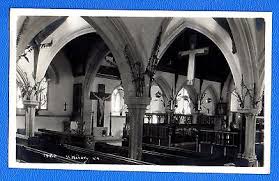
In a letter to the editor of the Western Morning News, Saturday March 5, 1932, W. Poynter-Adams records the existence of "six large silvered glass balls" hanging from six arches in the parish church of St. Hilary, near Goldsithney, Cornwall. These balls were referred to by one parishioner as "Witch-watchers", "intended to ward of witches from the Reserved Sacrament". These balls no longer hang in the church, but a mid-20th century photograph/postcard clearly shows that they did indeed hang in the arches as described. The size and patina of the St. Hilary "witch-watchers" appear to be very similar to this example in the Museum collection.
- Resource:
- Object
- Materials:
- Glass, metal
- Copyright ownership:
- Treetrunk Ltd.
These reflective glass balls were manufactured in England by Nailsea glass-makers from 1788 onwards.
The balls were intended to be suspended in a window or dark corner where they will reflect away evil and ill-fortune. Some believe that the glass ball will itself attract the influences of ill-luck and ill-wishing that would otherwise have fallen upon the household. Hence the witch ball should be regularly wiped clean.
Generally the balls are around 7 inches (18 centimetres) in diameter although some are much bigger. They are silvered in various colours or decorated in elaborate swirling patterns.
This ball was purchased from J. Barron & Sons, an antique shop in Mevagissey. The lady who ran the shop, who is now retired, recently (September 2017) visited the museum to see it. She told us that it hung in the shop for many years, and that the owner of this museum (presumably Cecil Williamson) kept coming into the shop at regular intervals trying to persuade them to sell it to him. Eventually, after her husband (who she ran the shop with) died, she agreed to sell it.
--------
In a letter to the editor of the Western Morning News, Saturday March 5, 1932, W. Poynter-Adams records the existence of "six large silvered glass balls" hanging from six arches in the parish church of St. Hilary, near Goldsithney, Cornwall. These balls were referred to by one parishioner as "Witch-watchers", "intended to ward of witches from the Reserved Sacrament". These balls no longer hang in the church, but a mid-20th century photograph/postcard clearly shows that they did indeed hang in the arches as described. The size and patina of the St. Hilary "witch-watchers" appear to be very similar to this example in the Museum collection.