1696 – ITALIAN AMULET AGAINST THE EVIL EYE
- Physical description:
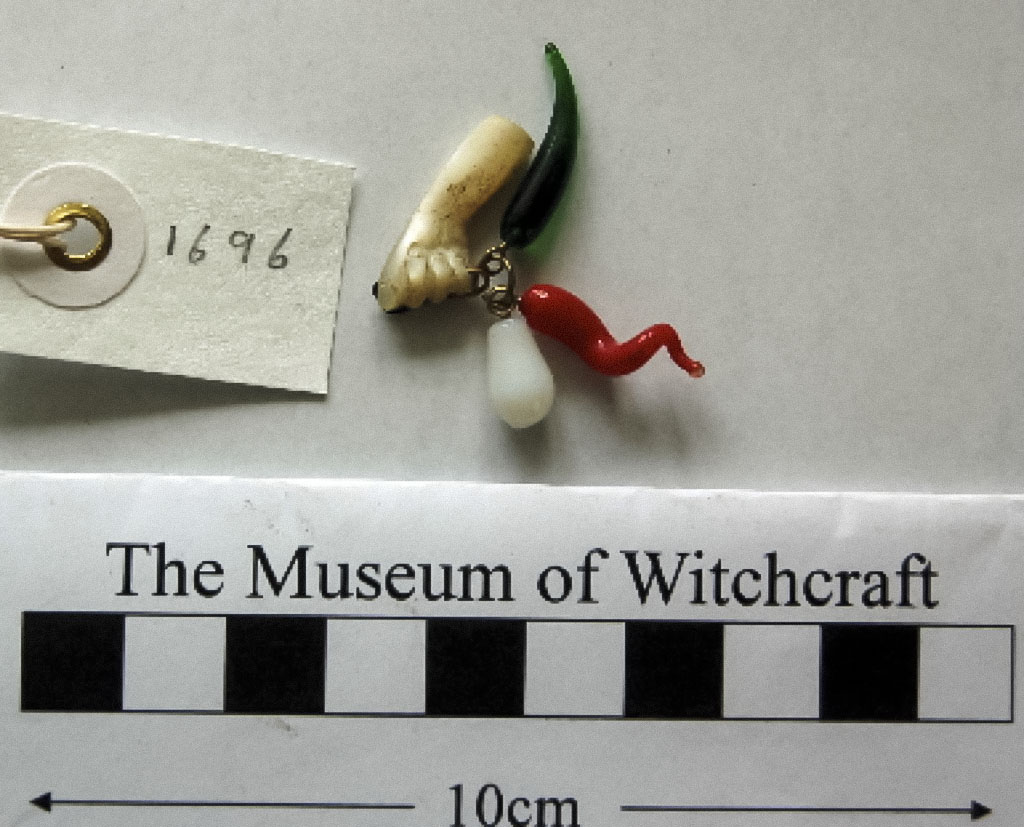
- Italian amulet against the evil eye - a hand carved from mother-of-pearl, holding a ring from which hang a white glass tear-drop shape and two glass horn-shapes, one green with a slight curve and one red and spiralling.
- Museum classification:
- Protection
- Size:
- 45 x 35 x 7
- Information:
Small horn-shaped amulets are common in Italy and are known as cornicelli. They are usually red and are often made of coral. The belief that horns repel bad luck, and in particular the evil eye, is widespread. It may be linked to horned gods, to the crescent moon and therefore moon goddesses, or simply to the way animals use their horns as a highly effective defensive weapon. Red - the colour of blood and therefore of life - is widely regarded as a lucky colour. Red cornicelli also resemble chilis, which - like garlic - are, again, believed to ward off evil.
There is a similar charm in Scarborough Museum (but without the hand and with the curved horn green rather than blue); the label describes the tear-drop shape as the breast of Diana, which apparently ensures that the owner will never be short of food; the charm was originally in the Lovett collection, and was collected in London in 1922 (information supplied by Tabitha Cadbury - see her report 'The Clarke Collection of Charms and Amulets' in the museum library).- Resource:
- Object
- Materials:
- Shell, glass, metal
- Copyright ownership:
- Treetrunk Ltd
Small horn-shaped amulets are common in Italy and are known as cornicelli. They are usually red and are often made of coral. The belief that horns repel bad luck, and in particular the evil eye, is widespread. It may be linked to horned gods, to the crescent moon and therefore moon goddesses, or simply to the way animals use their horns as a highly effective defensive weapon. Red - the colour of blood and therefore of life - is widely regarded as a lucky colour. Red cornicelli also resemble chilis, which - like garlic - are, again, believed to ward off evil.
There is a similar charm in Scarborough Museum (but without the hand and with the curved horn green rather than blue); the label describes the tear-drop shape as the breast of Diana, which apparently ensures that the owner will never be short of food; the charm was originally in the Lovett collection, and was collected in London in 1922 (information supplied by Tabitha Cadbury - see her report 'The Clarke Collection of Charms and Amulets' in the museum library).