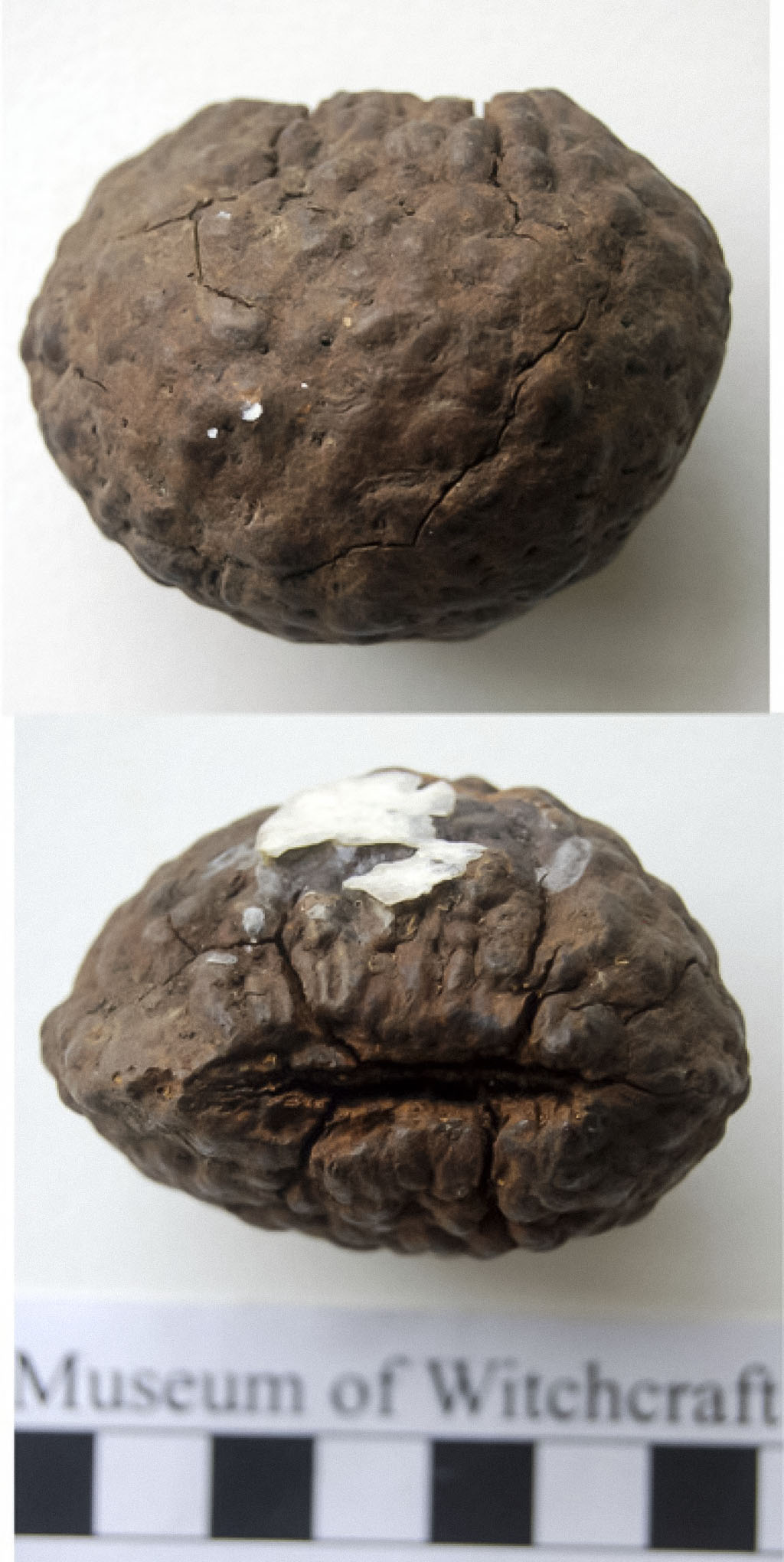
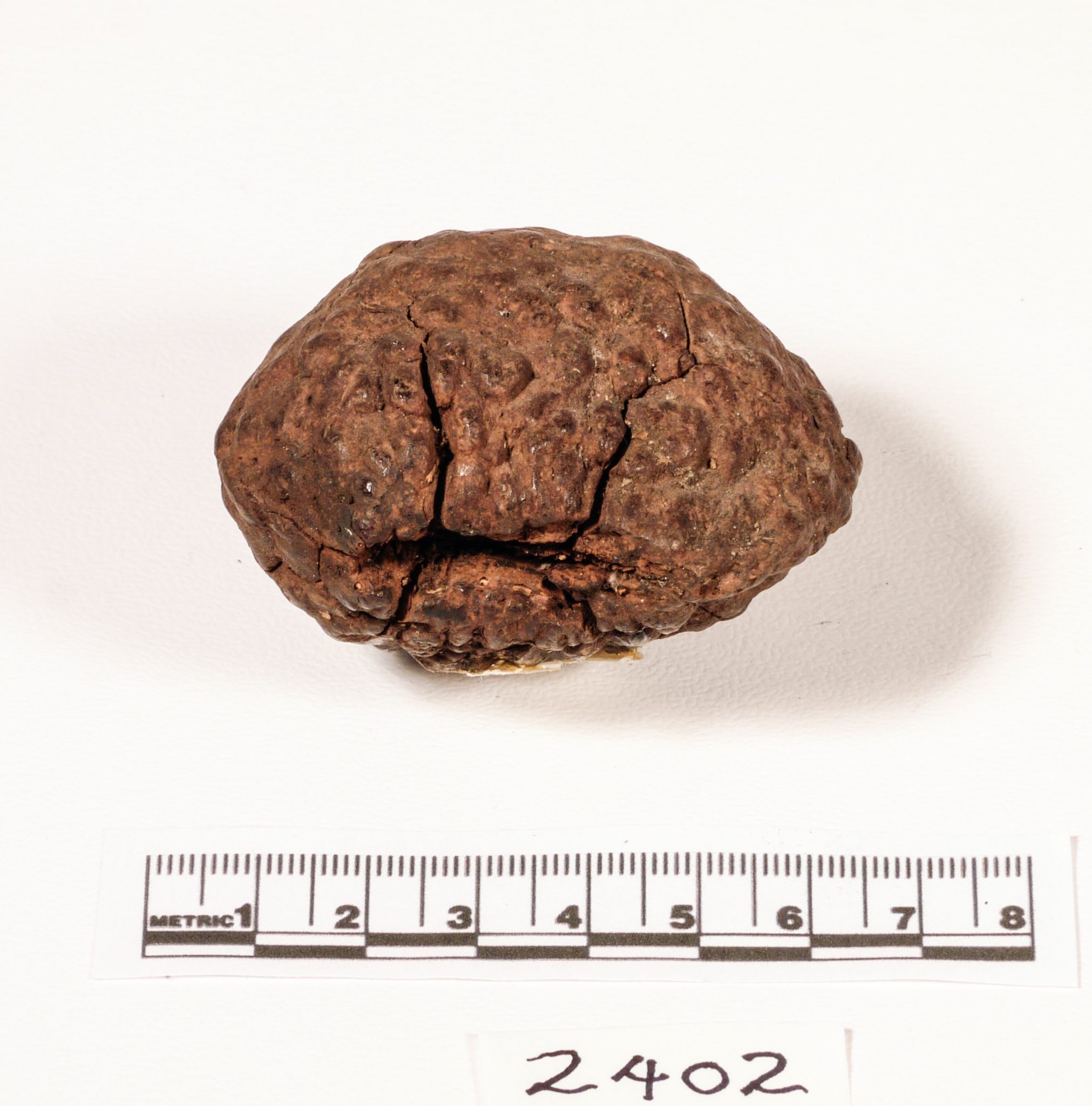
2402 – Seed
- Physical description:
- Large brown knobbly seed which rattles when shaken.
- Museum classification:
- Spells and charms
- Size:
- 60 x 45 x 40
- Information:
CWOLC 7310 reads:
"EAGLE STONES. Tradition has it that Eagles placed one or more of these "stones2 [sic] they are in fact a nut having an exceedingly tough outer skin protecting the inner fruit. When shaken the inner fruit can be heard to rattle against the hard outer shell in their nests. It was believed that the reason for the Eagles action lay in the fact, that without the Eagle Stone the eggs would not hatch. To obtain an Eagle Stone was no light undertaking consequently they were held in high esteem. In many places it was believed that if an expectant mother were to strap an Eagle Stone to her thigh, that it would help to give an easy delivery for her child."
Beans and seeds - especially those that rattle - were commonly used for charms and divination in the UK and around the world. They were often part of a shaman or 'witch doctor's kit. In the UK strange 'sea beans' washed up on the shore were popular. Paper accretions indicate that object may have been attached to a display board in the past. T.Cadbury, 21/09/2011.
The following information was provided in an email to the Museum in 2018:
Furthermore, in Occult Physick, (1660) it say of eagle stones, “It is good to be worn for the Stone… Feavers and Plague. It doth also dissolve the knobs of the Kings Evil (i.e. scrofula), being bound to the place grieved”.In Simon Forman's Diary (1564-1602) he writes for 1583, "The 17th of December I had my ring mad with the egles stone.".
I have read that the Italian scholar, priest, astrologer, Marsilo Ficino (1433-1499) says that the Eagle's Stone (aetite) is used to ease the pain of childbirth, and ascribes this ability to the astrological influence of the planet Venus and the Moon.
In his Diary, Forman says that he "cured the fellowe of Quidhampton of the king's evill",
Hence I believe Forman was saying that he had a ring made with such a stone set in it, especially to use for such purposes.
On loan to York Archaeological Trust for exhibition at the Merchant Adventurers' Hall from July 18th 2018 - February 19th 2019
- Resource:
- Object
- Materials:
- Plant
CWOLC 7310 reads:
"EAGLE STONES. Tradition has it that Eagles placed one or more of these "stones2 [sic] they are in fact a nut having an exceedingly tough outer skin protecting the inner fruit. When shaken the inner fruit can be heard to rattle against the hard outer shell in their nests. It was believed that the reason for the Eagles action lay in the fact, that without the Eagle Stone the eggs would not hatch. To obtain an Eagle Stone was no light undertaking consequently they were held in high esteem. In many places it was believed that if an expectant mother were to strap an Eagle Stone to her thigh, that it would help to give an easy delivery for her child."
Beans and seeds - especially those that rattle - were commonly used for charms and divination in the UK and around the world. They were often part of a shaman or 'witch doctor's kit. In the UK strange 'sea beans' washed up on the shore were popular. Paper accretions indicate that object may have been attached to a display board in the past. T.Cadbury, 21/09/2011.
The following information was provided in an email to the Museum in 2018:
I have read that the Italian scholar, priest, astrologer, Marsilo Ficino (1433-1499) says that the Eagle's Stone (aetite) is used to ease the pain of childbirth, and ascribes this ability to the astrological influence of the planet Venus and the Moon.
In his Diary, Forman says that he "cured the fellowe of Quidhampton of the king's evill",
Hence I believe Forman was saying that he had a ring made with such a stone set in it, especially to use for such purposes.
On loan to York Archaeological Trust for exhibition at the Merchant Adventurers' Hall from July 18th 2018 - February 19th 2019