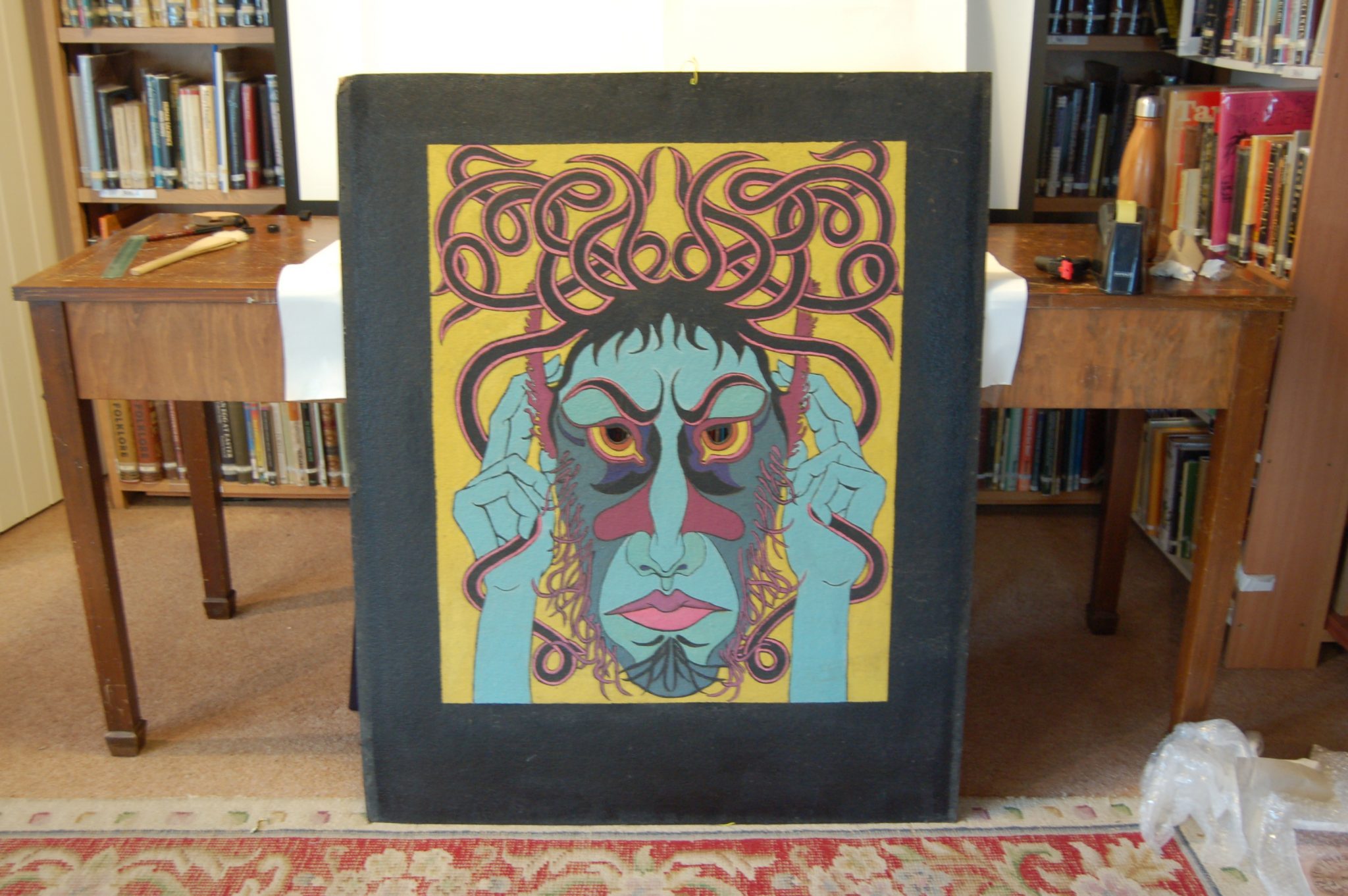
3956 – Witchs Cradle Panel painting
- Physical description:
- Painting on wooden board with holes cut where the eyes should be. String/wire attached on the back for hanging.
- Museum classification:
- Typhonian, OTO, Aleister Crowley
- Size:
- 1 m x 0.75 m approx
- Information:
For many years, this painting was part of the Museum display "The Witch's Cradle". Originally the painting was rigged up in front of red lights that glowed in the sockets of the eyes (cut-out).
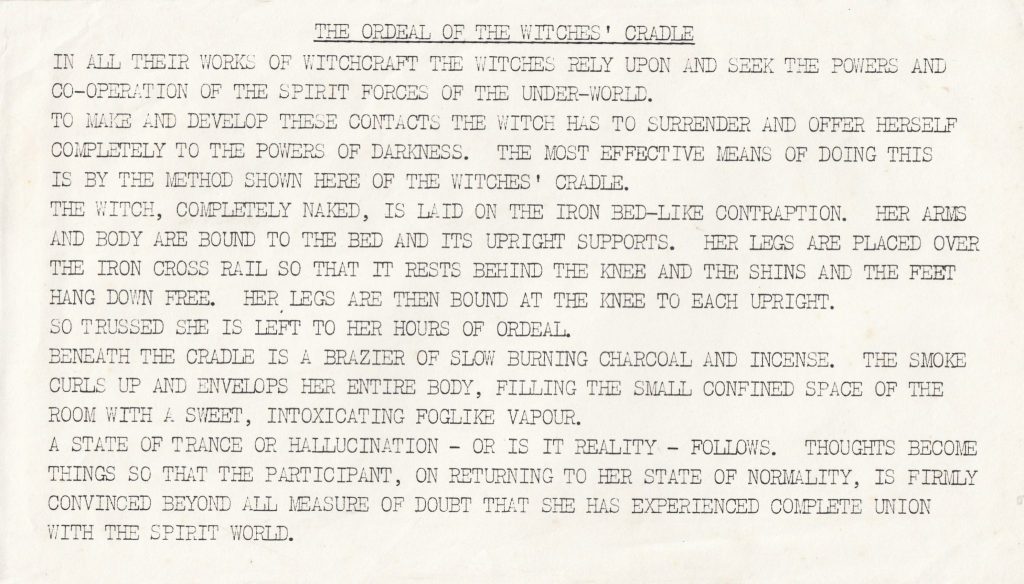
This is the description Cecil Williamson wrote of the Witch's Cradle (this is a typed interpretation card from the Museum archive - document number 7350):
Also see document number 9949.
For more details on this display see Steve Patterson's book "Cecil Williamson's Book of Witchcraft" (Troy Books) in the Museum library. In this book, Steve connects the cradle to William Seabrook's 1940 book, "Witchcraft its power in the world today."
Seabrook was an associate of Aleister Crowley.

The style suggests a work by Steffi Grant (a member of the British OTO, the Museum has several other pictures which were painted on wooden board from sketches originally drawn by Steffi). However, in 2018, Steffi was asked about the sketches and she doesn't remember creating this one. It does look a lot like the cover of Kenneth Grant's book "Snakewand" for which Steffi created the art.
The object may reflect Williamson's interest in and collaboration with the Typhonian O.T.O., and his working relationship with Kenneth and Steffi Grant. It is possible (this is speculative) that it is intended to represent Typhon (reasons for this speculation: snakes, fire flashing from eyes, connections with smoke and connections with the Grants). The triangle painting below the cradle (in the display) and the lotus and serpent candleholders suggest a connection with the Eastern mystical traditions (tantra) of which Kenneth Grant wrote a great deal (and we know Cecil read these books as his annotated copies are still in the Museum library).
A brief history of the Steffi Grant Collection
A set of original sketches and diagrams for a Museum display, reproductions of those diagrams in a larger scale and a double cubic altar.
Similar to the images Steffi Grant created for the Carfax Monographs (1959-1962) but created in 1951. See Kenneth and Steffi Grant’s Hidden Lore: Hermetic Glyphs (Fulgur Press) in the Museum library for more details.
Object numbers: 3941-3950 (inclusive),1163 and possibly 3956. Also double cubic altar (941) and angelic scrying tablets (1160).
Cecil Williamson’s notes and old interpretation cards from the Museum suggest that he had a profound respect for, and deep interest in, Aleister Crowley. See documents 8282 and 8277 and the interview with Cecil in Talking Stick magazine about Crowley (in the Museum library) for more on his attitude to him.
One letter sent to Gerald Yorke in 1952 (transcribed by Dave Evans from an original in the Warburg Institute) even suggests that the Museum may have been somehow inspired by Crowley. See documents 887 and 888.
The Museum used to have a lot of objects which were either inspired by Crowley or owned by him (according to Cecil) including a seven headed demon stick, Baphomet ring and paintings. There is also reference to a handwritten copy of the Book of the Law and a copy of Crowley’s funeral service (one wonders how this was obtained by Cecil – by purchase, gift from someone who was there or is it possible that Cecil attended the funeral?) See documents 9013, 10129 or search Crowley in documents to see the complete list).
One document (8267) mentions a range of magical drawings, made by a student while under the instruction of Aleister Crowley. In it, Cecil says that no excuse is made for their condition. It is highly likely that this card refers to the drawings created by Steffi Grant in 1951 for the Museum when it was at the Witches’s Mill on the Isle of Man (objects 3941-3950).
There are several documents in the Museum archive that relate to this display (for a look at the display itself see object 941, double cubic altar).
There are around 20 letters from Gerald Yorke. From these, we can infer that Cecil approached him asking for help establishing a temple room in the Mill. Gerald seems to have contacted Kenneth and Steffi Grant and liased with them about the display and it developed into a Temple which is mainly based on Crowley’s Book 4, Part 2. Gerald Yorke wrote a guidebook for it which includes substantial quotes from Book 4, Part 2. See document 692 for the complete text. Gerald Yorke also mentions John Symonds (Crowley’s literary executor and first biographer) in one letter and visiting the Mill with Lady Frieda Harris (who created the Thoth Tarot with Crowley) in another letter.
The designs were completed by Steffi and sent to Cecil with instructions. There are numerous letters from Kenneth and Steffi Grant which deal with this display (see 93, 96, 97, X98, 99, 100, 101).
Cecil does not seem to have paid Steffi for this work and Kenneth suggests in a letter that Cecil could pay for the British OTO manifesto to be printed in recompense for Steffi’s work on the display. Several letters mention this manifesto and the dye that was to be used in making it.
Cecil obviously held on to many of these objects and drawings when he moved the Museum from the Isle of Man. He must also have written to Kenneth Anger (probably in 1955) as document number 271 is a letter from Anger while at Cefalu. It seems that Cecil was trying to acquire Crowley objects from the Abbey and that he and Kenneth Anger were going to create some sort of reconstruction of it at the Museum while it was in Windsor.
It is possible that one more object was created by Steffi Grant, this is object number 3956 (Witch’s Cradle painting). A photograph of this object was shown to Steffi in 2018 by Professor Henrik Bogdan and she does not remember creating it. However it is similar to the style of her work (see front cover of Kenneth Grant’s book ‘Snakewand’).
Cecil seemed to admire the Grants long after their collaboration had ended. He purchased and heavily annotated a first edition of Kenneth Grant’s “Magical Revival” (now in the Museum library). A letter in the Museum archive (document 180) was written by Cecil in 1982 and talks warmly of the Grants as being knowledgeable occultists and lovely people.
- Resource:
- Painting
- Materials:
- Water-based paint on board
- Copyright ownership:
- MWM
For many years, this painting was part of the Museum display "The Witch's Cradle". Originally the painting was rigged up in front of red lights that glowed in the sockets of the eyes (cut-out).
This is the description Cecil Williamson wrote of the Witch's Cradle (this is a typed interpretation card from the Museum archive - document number 7350):
Also see document number 9949.
For more details on this display see Steve Patterson's book "Cecil Williamson's Book of Witchcraft" (Troy Books) in the Museum library. In this book, Steve connects the cradle to William Seabrook's 1940 book, "Witchcraft its power in the world today."
Seabrook was an associate of Aleister Crowley.
The style suggests a work by Steffi Grant (a member of the British OTO, the Museum has several other pictures which were painted on wooden board from sketches originally drawn by Steffi). However, in 2018, Steffi was asked about the sketches and she doesn't remember creating this one. It does look a lot like the cover of Kenneth Grant's book "Snakewand" for which Steffi created the art.
The object may reflect Williamson's interest in and collaboration with the Typhonian O.T.O., and his working relationship with Kenneth and Steffi Grant. It is possible (this is speculative) that it is intended to represent Typhon (reasons for this speculation: snakes, fire flashing from eyes, connections with smoke and connections with the Grants). The triangle painting below the cradle (in the display) and the lotus and serpent candleholders suggest a connection with the Eastern mystical traditions (tantra) of which Kenneth Grant wrote a great deal (and we know Cecil read these books as his annotated copies are still in the Museum library).
A brief history of the Steffi Grant Collection
A set of original sketches and diagrams for a Museum display, reproductions of those diagrams in a larger scale and a double cubic altar.
Similar to the images Steffi Grant created for the Carfax Monographs (1959-1962) but created in 1951. See Kenneth and Steffi Grant’s Hidden Lore: Hermetic Glyphs (Fulgur Press) in the Museum library for more details.
Object numbers: 3941-3950 (inclusive),1163 and possibly 3956. Also double cubic altar (941) and angelic scrying tablets (1160).
Cecil Williamson’s notes and old interpretation cards from the Museum suggest that he had a profound respect for, and deep interest in, Aleister Crowley. See documents 8282 and 8277 and the interview with Cecil in Talking Stick magazine about Crowley (in the Museum library) for more on his attitude to him.
One letter sent to Gerald Yorke in 1952 (transcribed by Dave Evans from an original in the Warburg Institute) even suggests that the Museum may have been somehow inspired by Crowley. See documents 887 and 888.
The Museum used to have a lot of objects which were either inspired by Crowley or owned by him (according to Cecil) including a seven headed demon stick, Baphomet ring and paintings. There is also reference to a handwritten copy of the Book of the Law and a copy of Crowley’s funeral service (one wonders how this was obtained by Cecil – by purchase, gift from someone who was there or is it possible that Cecil attended the funeral?) See documents 9013, 10129 or search Crowley in documents to see the complete list).
One document (8267) mentions a range of magical drawings, made by a student while under the instruction of Aleister Crowley. In it, Cecil says that no excuse is made for their condition. It is highly likely that this card refers to the drawings created by Steffi Grant in 1951 for the Museum when it was at the Witches’s Mill on the Isle of Man (objects 3941-3950).
There are several documents in the Museum archive that relate to this display (for a look at the display itself see object 941, double cubic altar).
There are around 20 letters from Gerald Yorke. From these, we can infer that Cecil approached him asking for help establishing a temple room in the Mill. Gerald seems to have contacted Kenneth and Steffi Grant and liased with them about the display and it developed into a Temple which is mainly based on Crowley’s Book 4, Part 2. Gerald Yorke wrote a guidebook for it which includes substantial quotes from Book 4, Part 2. See document 692 for the complete text. Gerald Yorke also mentions John Symonds (Crowley’s literary executor and first biographer) in one letter and visiting the Mill with Lady Frieda Harris (who created the Thoth Tarot with Crowley) in another letter.
The designs were completed by Steffi and sent to Cecil with instructions. There are numerous letters from Kenneth and Steffi Grant which deal with this display (see 93, 96, 97, X98, 99, 100, 101).
Cecil does not seem to have paid Steffi for this work and Kenneth suggests in a letter that Cecil could pay for the British OTO manifesto to be printed in recompense for Steffi’s work on the display. Several letters mention this manifesto and the dye that was to be used in making it.
Cecil obviously held on to many of these objects and drawings when he moved the Museum from the Isle of Man. He must also have written to Kenneth Anger (probably in 1955) as document number 271 is a letter from Anger while at Cefalu. It seems that Cecil was trying to acquire Crowley objects from the Abbey and that he and Kenneth Anger were going to create some sort of reconstruction of it at the Museum while it was in Windsor.
It is possible that one more object was created by Steffi Grant, this is object number 3956 (Witch’s Cradle painting). A photograph of this object was shown to Steffi in 2018 by Professor Henrik Bogdan and she does not remember creating it. However it is similar to the style of her work (see front cover of Kenneth Grant’s book ‘Snakewand’).
Cecil seemed to admire the Grants long after their collaboration had ended. He purchased and heavily annotated a first edition of Kenneth Grant’s “Magical Revival” (now in the Museum library). A letter in the Museum archive (document 180) was written by Cecil in 1982 and talks warmly of the Grants as being knowledgeable occultists and lovely people.