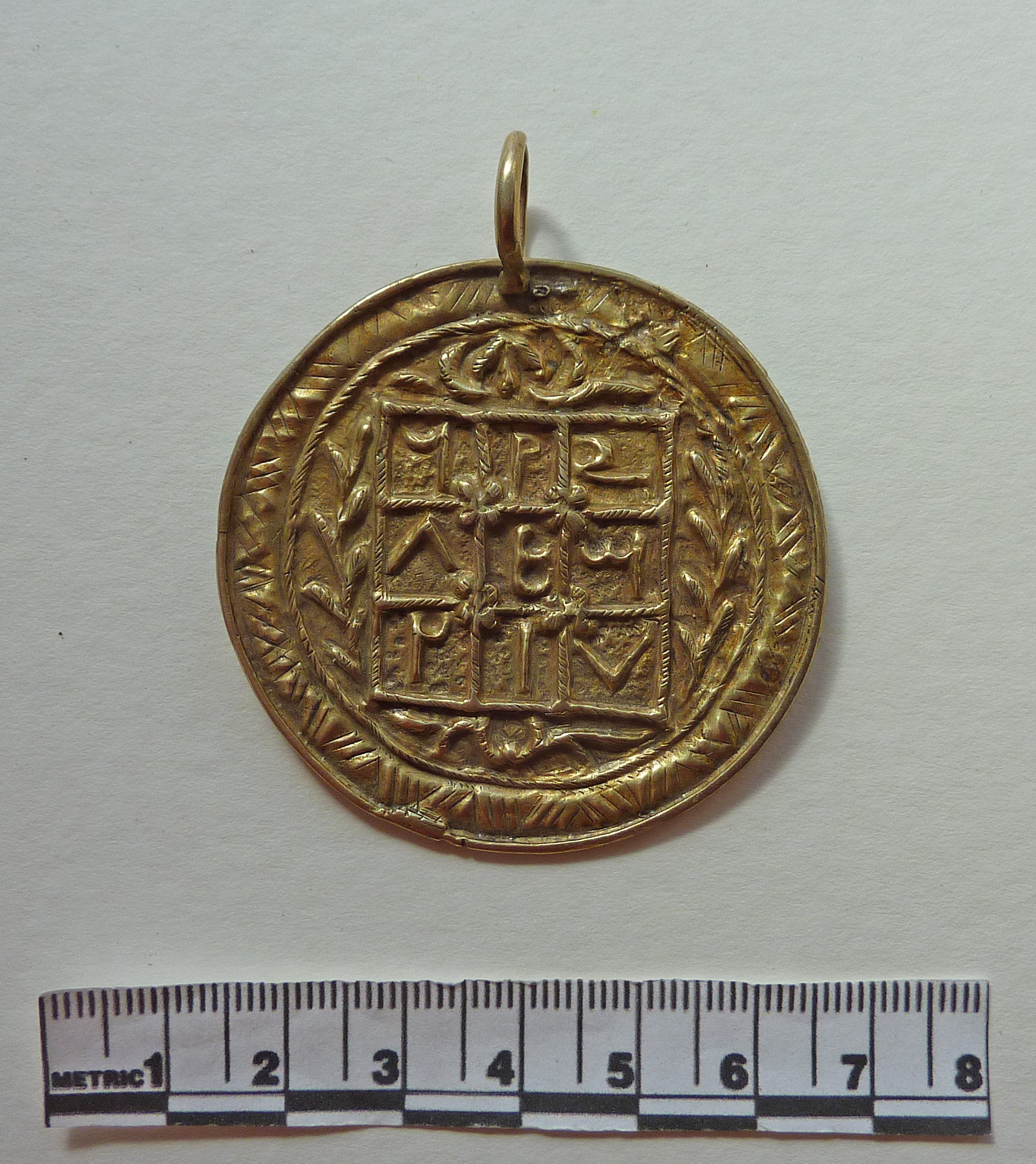
2398 – Taweez amulet pendant
- Physical description:
- Circular pendant with suspension ring at top. At the centre is a grid of nine squares each with a symbol inside it. A charm of the kind known as a taweez.
- Museum classification:
- Spells and charms
- Size:
- 60x50x2
- Information:
Object found with Christian items with Cyrillic script, so need to check whether symbols are Cyrillic text. T.Cadbury, 21/09/2011.
This is a taweez (from the Arabic ta'widh) - a charm or amulet used for healing, protection or love. It is similar to a healing taweez depicted on several Internet sites, for example http://getislamicwazifa.com/taweez-cure-disease/
These amulets are widely used in Arab countries, Turkey, the Balkans, Pakistan etc. They are associated with Islamic culture and often incorporate Islamic Names of God or verses from the Qur'an, but many people who follow a strict interpretation of Islam regard them as a form of idolatry.
This may be because some of these amulets have a pre-Islamic Animist origin. For example, Toby Green, writing about his investigation of West African magic in the 1990s in his book 'Meeting the Invisible Man', describes an amulet for protection against your enemies' weapons that involved putting a paper with extracts from the Qur'an written on it inside a ram's horn. However, Robert Milligan, writing only about 85 years earlier in his book 'The Fetish Folk of West Africa' (1912), describes an amulet for protection against your enemies' weapons that consisted of a goat's horn believed to contain a spirit. It would appear that the amulet had been Islamised, with the extracts from the Qur'an putting spiritual power inside the horn as an alternative to the actual spirit believed to be inside the horn in the earlier amulet.
In Senegalese wrestling culture there are elaborate pre-match rituals designed to make contact with, and invoke the help of, spirits. These involve wearing square amulets made of leather (or similar animal hide) containing verses from the Qur'an written on paper, as well as using magical potions (which the wrestlers pour over themselves) and performing shamanic dances. (See 'Africa's Superstar Gladiators', part of Channel 4's 'Unreported World' series, broadcast on 5th May 2017, and presented by Seyi Rhodes.) The wrestlers do not see any conflict between the magical elements of these rituals and their Islamic beliefs - on the contrary they are proud of the fact that they are preserving spiritual traditions that they see as part of their identity as wrestlers.
So in spite of the condemnation of magic as idolatry by some Muslims (and on a significant number of Muslim websites), it would appear that for many other Muslims the fact that they have adopted Islam as their official religion does not prevent them from continuing to honour local spiritual traditions as well.
Does this have implications for the interpretation of the European witch hunts, when magic was also widely condemned as idolatry by the authorities? Could it be that European magical practitioners were also knowingly using local pre-Christian spiritual (shamanic?) traditions, which they viewed as distinct from, but compatible with, Christianity?
See also the amulets MoWaM id. nos. 1707 and 1970.
One of the items that was on loan to the 'Witchery' exhibition at the Royal Villa of Monza, Italy, Winter 2022-23.
- Resource:
- Object
- Materials:
- Metal
Object found with Christian items with Cyrillic script, so need to check whether symbols are Cyrillic text. T.Cadbury, 21/09/2011.
This is a taweez (from the Arabic ta'widh) - a charm or amulet used for healing, protection or love. It is similar to a healing taweez depicted on several Internet sites, for example http://getislamicwazifa.com/taweez-cure-disease/
These amulets are widely used in Arab countries, Turkey, the Balkans, Pakistan etc. They are associated with Islamic culture and often incorporate Islamic Names of God or verses from the Qur'an, but many people who follow a strict interpretation of Islam regard them as a form of idolatry.
This may be because some of these amulets have a pre-Islamic Animist origin. For example, Toby Green, writing about his investigation of West African magic in the 1990s in his book 'Meeting the Invisible Man', describes an amulet for protection against your enemies' weapons that involved putting a paper with extracts from the Qur'an written on it inside a ram's horn. However, Robert Milligan, writing only about 85 years earlier in his book 'The Fetish Folk of West Africa' (1912), describes an amulet for protection against your enemies' weapons that consisted of a goat's horn believed to contain a spirit. It would appear that the amulet had been Islamised, with the extracts from the Qur'an putting spiritual power inside the horn as an alternative to the actual spirit believed to be inside the horn in the earlier amulet.
In Senegalese wrestling culture there are elaborate pre-match rituals designed to make contact with, and invoke the help of, spirits. These involve wearing square amulets made of leather (or similar animal hide) containing verses from the Qur'an written on paper, as well as using magical potions (which the wrestlers pour over themselves) and performing shamanic dances. (See 'Africa's Superstar Gladiators', part of Channel 4's 'Unreported World' series, broadcast on 5th May 2017, and presented by Seyi Rhodes.) The wrestlers do not see any conflict between the magical elements of these rituals and their Islamic beliefs - on the contrary they are proud of the fact that they are preserving spiritual traditions that they see as part of their identity as wrestlers.
So in spite of the condemnation of magic as idolatry by some Muslims (and on a significant number of Muslim websites), it would appear that for many other Muslims the fact that they have adopted Islam as their official religion does not prevent them from continuing to honour local spiritual traditions as well.
Does this have implications for the interpretation of the European witch hunts, when magic was also widely condemned as idolatry by the authorities? Could it be that European magical practitioners were also knowingly using local pre-Christian spiritual (shamanic?) traditions, which they viewed as distinct from, but compatible with, Christianity?
See also the amulets MoWaM id. nos. 1707 and 1970.
One of the items that was on loan to the 'Witchery' exhibition at the Royal Villa of Monza, Italy, Winter 2022-23.