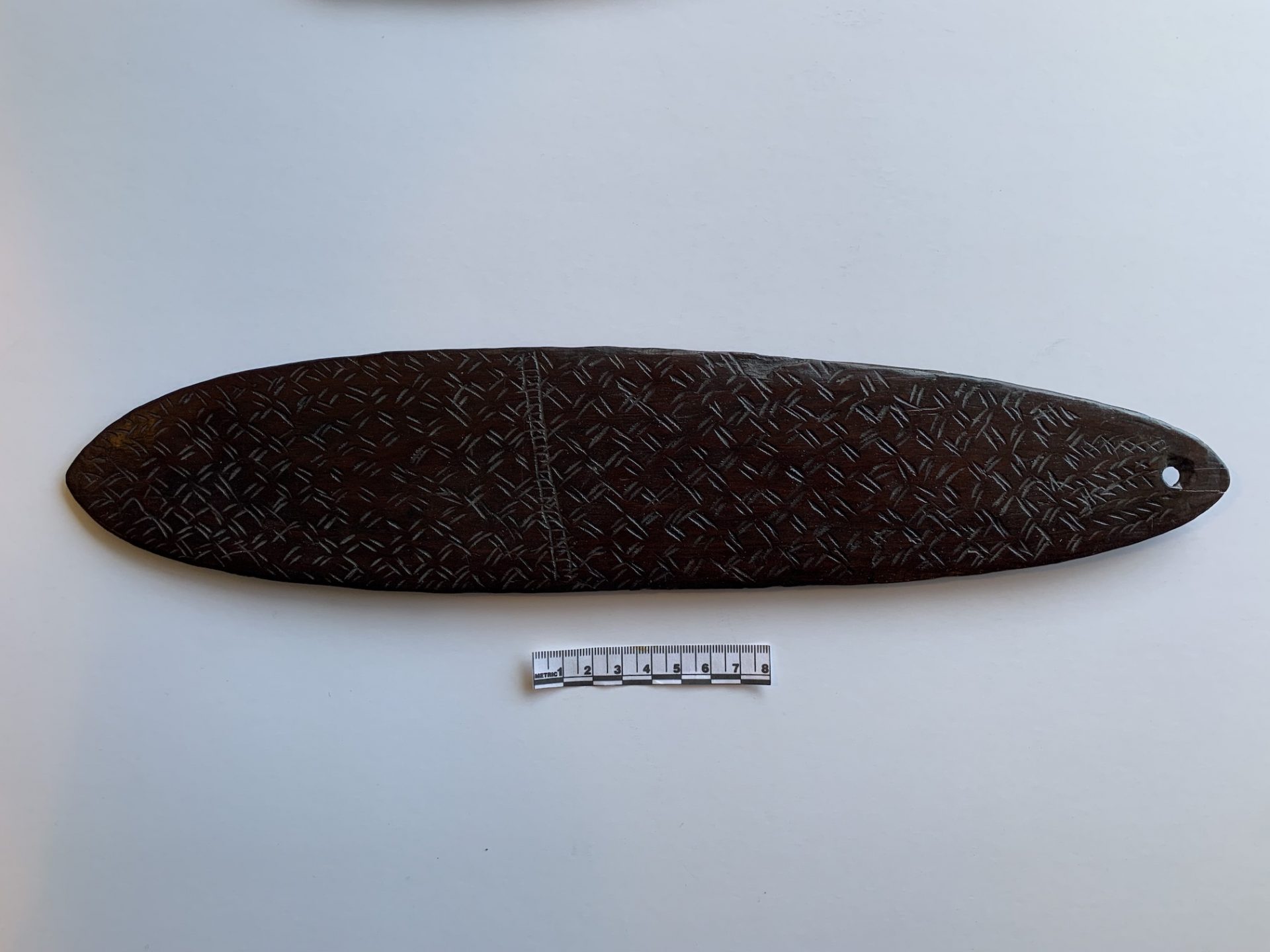
506 – Bull Roarers: Wind Roarers x 2
- Physical description:
- Wind/Bull roarer, approximately 9" x 2" pierced at one end. Shallow carving of an angular design. smaller one 7" x 1.5" has spiral design Used for summoning spirits or raising spirit power.
- Museum classification:
- Working Tools
- Size:
- 200mm
- Information:
When a west country witch wishes to draw to her spirit forces when working in the open countryside, she makes use of a wind roarer, being a flat section of shaped hard wood secured to a length of stout pliable string which is then rotated at arm's length at speed around the head. The sound emitted varies in pitch depending on the blade size and speed of rotation. By this means strange wailing sounds can be created. Little wonder that the spirits come flocking in to see what all the ghastly moaning is about. (Text by Cecil Williamson)
The earliest surviving bullroarers are from the Ukraine and date to 17,000 BC. The use of bullroarers in shamanic rituals has been recorded on every inhabited continent.
There is a beautiful brightly coloured example in the Children's Museum of Indianapolis. It was used by the Hopi people as part of their Kachina ceremonies, which involve masks embodying the spirit of a deity. Interestingly, these rituals bear a striking resemblance to the Padstow May Day Oss ceremony here in Cornwall. 'Gentian Hill', a novel by Elizabeth Goudge published in 1946, describes a Devon farmworker using a bullroarer to summon spirits.
Scientific evidence suggests that low-frequency infrasound of the kind produced by bullroarers can create disturbing emotions such as sorrow and fear ("Echoes: The Newsletter of the Acoustical Society of America", vol.13, no.4, Fall 2003), and can help to induce trance states.- Resource:
- Object
- Materials:
- wood
- Copyright ownership:
- Copyright to The Museum of Witchcraft Ltd.
When a west country witch wishes to draw to her spirit forces when working in the open countryside, she makes use of a wind roarer, being a flat section of shaped hard wood secured to a length of stout pliable string which is then rotated at arm's length at speed around the head. The sound emitted varies in pitch depending on the blade size and speed of rotation. By this means strange wailing sounds can be created. Little wonder that the spirits come flocking in to see what all the ghastly moaning is about. (Text by Cecil Williamson)
The earliest surviving bullroarers are from the Ukraine and date to 17,000 BC. The use of bullroarers in shamanic rituals has been recorded on every inhabited continent.
There is a beautiful brightly coloured example in the Children's Museum of Indianapolis. It was used by the Hopi people as part of their Kachina ceremonies, which involve masks embodying the spirit of a deity. Interestingly, these rituals bear a striking resemblance to the Padstow May Day Oss ceremony here in Cornwall. 'Gentian Hill', a novel by Elizabeth Goudge published in 1946, describes a Devon farmworker using a bullroarer to summon spirits.
Scientific evidence suggests that low-frequency infrasound of the kind produced by bullroarers can create disturbing emotions such as sorrow and fear ("Echoes: The Newsletter of the Acoustical Society of America", vol.13, no.4, Fall 2003), and can help to induce trance states.