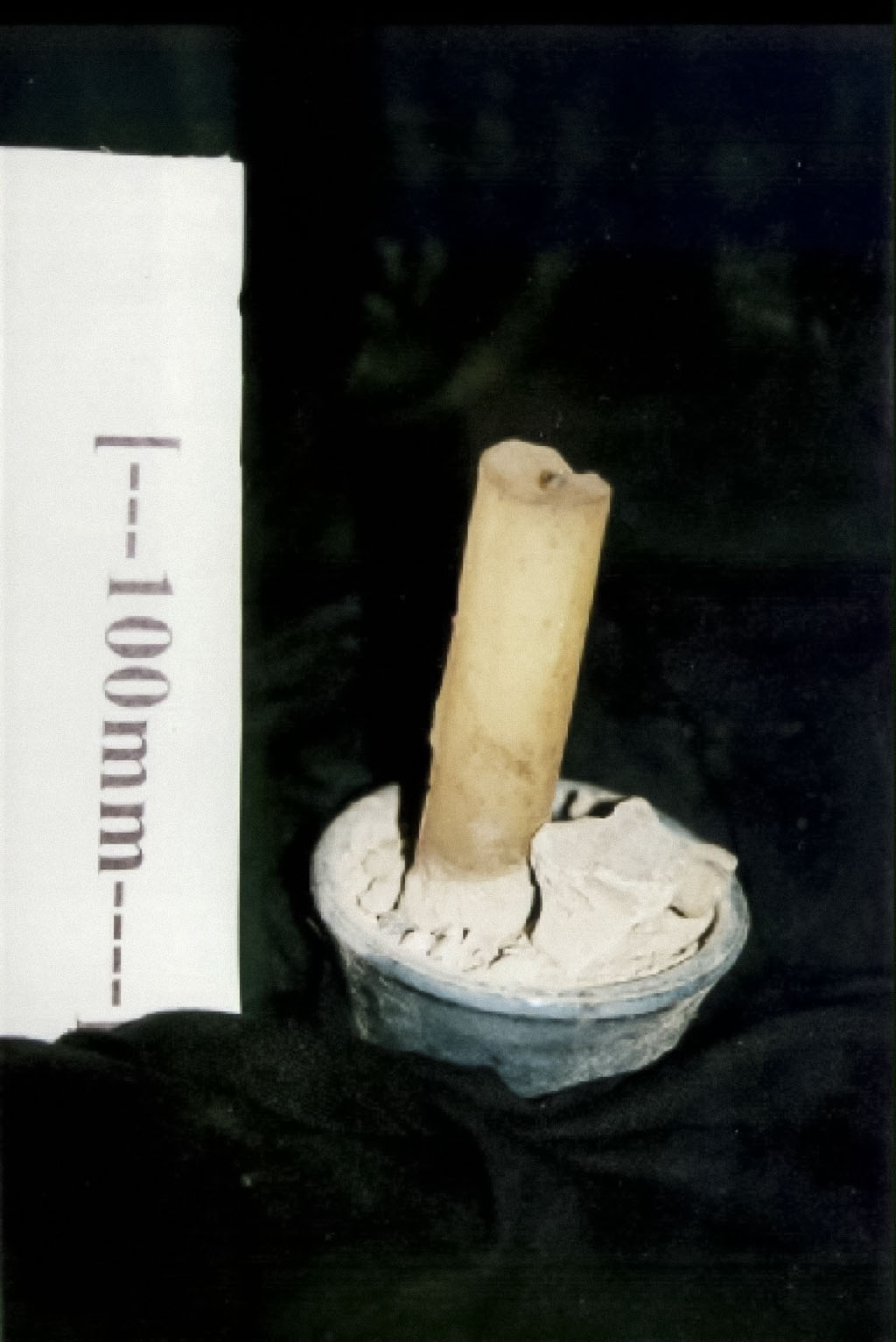
497 – Candle, dust and skull fragment
- Physical description:
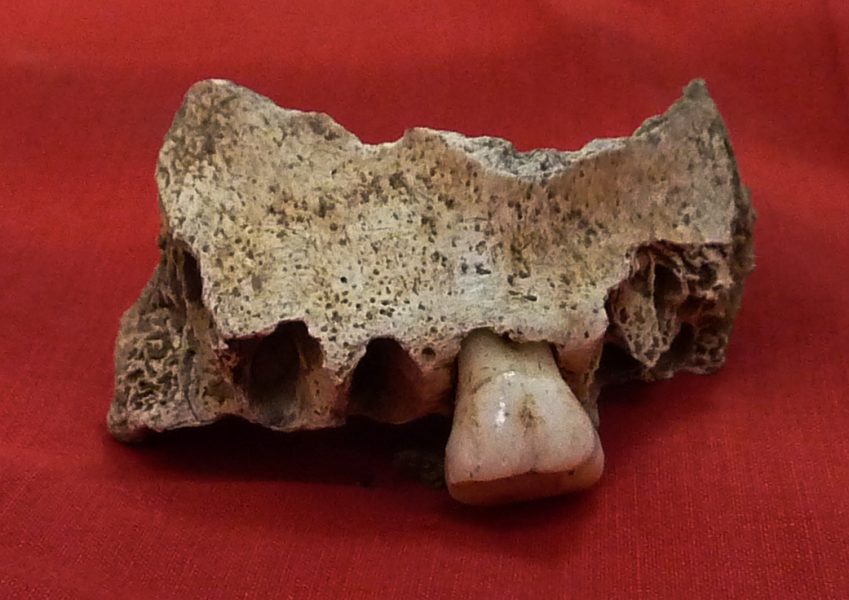
- Originally a candle set in a small blue china bowl of grave dust with a skull fragment including a tooth. However, the candle was lost in the 2004 flood.
- Museum classification:
- Spells & charms
- Size:
- 100mm
- Information:
 See 278, 349 and 1731.
Grave dust was often an ingredient of the magic powders used by wise women.
An Anglo-Saxon spell to prevent miscarriage involved the pregnant woman folding a handful of grave dust into a length of cloth and then selling it to a cloth merchant.
In the Pendle witchcraft case of 1612, four human teeth were found at Malking Tower, the home of a family of cunning folk. The 19th century Cornish folklorist William Bottrell describes cunning folk giving clients human teeth or grave dust to carry to prevent fits.
For comparatively modern examples of human teeth with hanging rings for use as good luck or healing charms see nos. 2270 and 2322.
The Lovett Collection in the Cuming Museum includes a bag containing a tooth (it's not clear whether it's human or animal), which was worn by a child to ease teething. Scarborough Museum has a "tooth of a dead man" which was worn hung round the neck of a child to prevent convulsions caused by teething (information supplied by Tabitha Cadbury - see her report 'The Clarke Collection of Charms and Amulets' in the museum library).The Horniman Museum has a West African shamanic headdress made from human teeth, object id. no. nn19544. The use of skulls and teeth in West African magic is usually related to accessing the power of ancestral spirits (see Robert Milligan, 'The Fetish Folk of West Africa', 1912).
Reliquary pendants, holding teeth or fragments of bone from saints, were sometimes worn by Church dignitaries in the Middle Ages. See, for example, the pendant in the British Museum which belonged to the Bishop of Galloway (see: http://www.learn.columbia.edu/treasuresofheaven/relics/Reliquary-Pendant-72.php). It is interesting to speculate that this kind of reverence for saints' relics may be a Christianisation of ancient animist beliefs about ancestral spirits.
Original text by Cecil Williamson: "This display consists of cleverly worked human bone finger rings. Sixteen sections of human bone strung on to a string and used for casting divinations. The hand of a dead man (a long story there), a wooden bowl with human skull fragments used for grating as you do with a nutmeg so as to produce a sprinkling of skull powder, and a corpse candle set in a small bowl of grave dust with an unchurched dead man's tooth. Horrible - you say - fiddlesticks. The witch of gallows hill would soon demonstrate to you how you can from such things learn to acquire a moral strength - develop a state of fearlessness and thereby gain a great peace of mind. All of which can be won simply by accepting and learning to live with the living dead."
- Resource:
- Object
- Materials:
- china, dust, bone, wax
- Copyright ownership:
- Copyright to The Museum of Witchcraft Ltd.
See 278, 349 and 1731.
Grave dust was often an ingredient of the magic powders used by wise women.
An Anglo-Saxon spell to prevent miscarriage involved the pregnant woman folding a handful of grave dust into a length of cloth and then selling it to a cloth merchant.
In the Pendle witchcraft case of 1612, four human teeth were found at Malking Tower, the home of a family of cunning folk. The 19th century Cornish folklorist William Bottrell describes cunning folk giving clients human teeth or grave dust to carry to prevent fits.
For comparatively modern examples of human teeth with hanging rings for use as good luck or healing charms see nos. 2270 and 2322.
The Lovett Collection in the Cuming Museum includes a bag containing a tooth (it's not clear whether it's human or animal), which was worn by a child to ease teething. Scarborough Museum has a "tooth of a dead man" which was worn hung round the neck of a child to prevent convulsions caused by teething (information supplied by Tabitha Cadbury - see her report 'The Clarke Collection of Charms and Amulets' in the museum library).
The Horniman Museum has a West African shamanic headdress made from human teeth, object id. no. nn19544. The use of skulls and teeth in West African magic is usually related to accessing the power of ancestral spirits (see Robert Milligan, 'The Fetish Folk of West Africa', 1912).
Reliquary pendants, holding teeth or fragments of bone from saints, were sometimes worn by Church dignitaries in the Middle Ages. See, for example, the pendant in the British Museum which belonged to the Bishop of Galloway (see: http://www.learn.columbia.edu/treasuresofheaven/relics/Reliquary-Pendant-72.php). It is interesting to speculate that this kind of reverence for saints' relics may be a Christianisation of ancient animist beliefs about ancestral spirits.
Original text by Cecil Williamson: "This display consists of cleverly worked human bone finger rings. Sixteen sections of human bone strung on to a string and used for casting divinations. The hand of a dead man (a long story there), a wooden bowl with human skull fragments used for grating as you do with a nutmeg so as to produce a sprinkling of skull powder, and a corpse candle set in a small bowl of grave dust with an unchurched dead man's tooth. Horrible - you say - fiddlesticks. The witch of gallows hill would soon demonstrate to you how you can from such things learn to acquire a moral strength - develop a state of fearlessness and thereby gain a great peace of mind. All of which can be won simply by accepting and learning to live with the living dead."