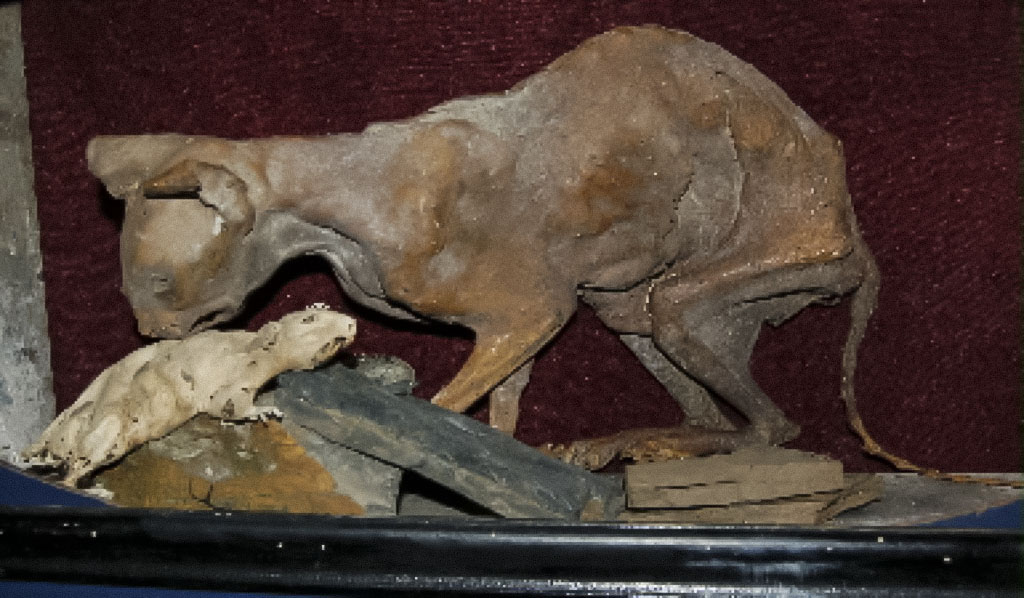
1494 – Red Concealed Cat and 2 rats
- Physical description:
- Naturally mummified cat and rat, posed to look as if the cat is catching the rat.
- Museum classification:
- Protection
- Size:
- 235x490x120, 40x210x45, 100x2020x30
- Information:
l Protection magic to deter rats and mice, and perhaps also other misfortunes or evil spirits.
These cats are a surprisingly common find in old buildings. Often they are posed with dead rats, making it clear that both the cat and the rat were dead before being placed in position. One found at Woburn Abbey, and now in the Natural History Museum, had even had its internal organs removed to help to preserve it. On the other hand, one found in Suffolk had its paws tied together, suggesting it may have been deposited alive, although the binding may have been symbolic, to restrain the cat's spirit. For examples, see 'West Yorkshire Folk Tales' by John Billingsley.
A visitor to the museum described seeing one of these cats attached over the door of her uncle's barn in the 1960s.In the Channel 4 TV series 'From Russia to Iran: Crossing the Wild Frontier' (broadcast in 2017), the presenter Levison Wood came across a mummified cat attached to the wall inside a metal-working workshop in Azerbaijan. The current owner of the workshop said it had been there for 150 years, and the cat had belonged to a previous master of the workshop, and the family had loved the cat so much they couldn't bear to be parted from him when he died. [Of course the owner of the workshop may not have wanted to talk to a Western stranger about any possible magical significance the cat might have had, or the magical significance could have been forgotten over time. However, the suggestion that this was a particularly highly valued cat perhaps supports the idea that these cats were not killed as sacrifices but died of natural causes and had their bodies then preserved because they were felt to be special in some way. It is worth noting that cats are highly regarded in Islamic cultures in the Middle East and Central Asia, so it is unlikely the cat would have been deliberately killed.]
In connection with the use of cats in protection magic, a visitor to the museum told us that there is a Church of England school in Chelmsford, built in 1887, that has two 'cat's paw bricks' used in the walls to protect it from witchcraft. These are bricks with the imprint of a cat's paw on them..
Another visitor to the museum told us that his local pub has the body of a dog in the wall.
Another visitor found the lower jaw of a sheep or goat between the rafters of the floor of her bedroom in a house built in the 16th century.- Resource:
- Object
- Materials:
- Animal
- Copyright ownership:
- Treetrunk Ltd.
l Protection magic to deter rats and mice, and perhaps also other misfortunes or evil spirits.
These cats are a surprisingly common find in old buildings. Often they are posed with dead rats, making it clear that both the cat and the rat were dead before being placed in position. One found at Woburn Abbey, and now in the Natural History Museum, had even had its internal organs removed to help to preserve it. On the other hand, one found in Suffolk had its paws tied together, suggesting it may have been deposited alive, although the binding may have been symbolic, to restrain the cat's spirit. For examples, see 'West Yorkshire Folk Tales' by John Billingsley.
A visitor to the museum described seeing one of these cats attached over the door of her uncle's barn in the 1960s.
In the Channel 4 TV series 'From Russia to Iran: Crossing the Wild Frontier' (broadcast in 2017), the presenter Levison Wood came across a mummified cat attached to the wall inside a metal-working workshop in Azerbaijan. The current owner of the workshop said it had been there for 150 years, and the cat had belonged to a previous master of the workshop, and the family had loved the cat so much they couldn't bear to be parted from him when he died. [Of course the owner of the workshop may not have wanted to talk to a Western stranger about any possible magical significance the cat might have had, or the magical significance could have been forgotten over time. However, the suggestion that this was a particularly highly valued cat perhaps supports the idea that these cats were not killed as sacrifices but died of natural causes and had their bodies then preserved because they were felt to be special in some way. It is worth noting that cats are highly regarded in Islamic cultures in the Middle East and Central Asia, so it is unlikely the cat would have been deliberately killed.]
In connection with the use of cats in protection magic, a visitor to the museum told us that there is a Church of England school in Chelmsford, built in 1887, that has two 'cat's paw bricks' used in the walls to protect it from witchcraft. These are bricks with the imprint of a cat's paw on them.
.
Another visitor to the museum told us that his local pub has the body of a dog in the wall.
Another visitor found the lower jaw of a sheep or goat between the rafters of the floor of her bedroom in a house built in the 16th century.