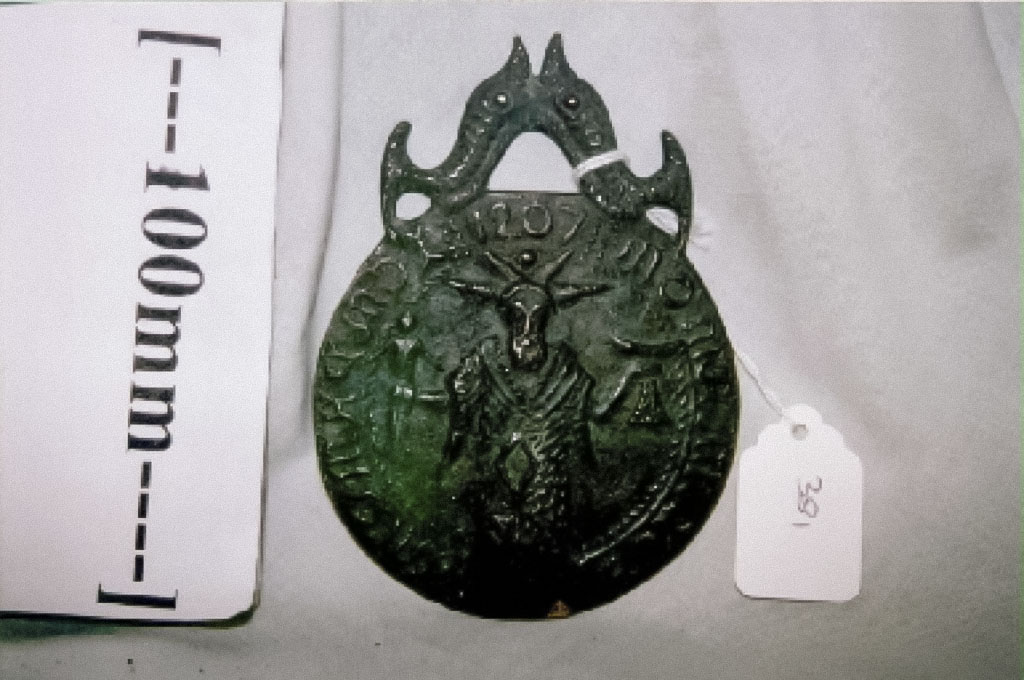
354 – pilgrim badge Medallion
- Physical description:
- Large coin-like medallion with ancient script on border and two fishes forming loop to hang it from. Date(?) 1207 on one side. On each side a robed, bearded figure, one with a key hung round his neck, the other with a mask or head.
- Museum classification:
- Spells and Charms
- Size:
- 100 x 125mm
- Information:
Original text by Cecil Williamson: 'This strange medallion came to the W.R.C. [Witchcraft Research Centre] with a long story. In brief: a winter storm, ship-wreck and strange men speaking a foreign tongue rescued from the sea while others lost and drowned. One of the rescued, as a token of thanks to his rescuer, presented him with this odd object. In no time at all it was reputed to have magical powers, and so many people sought its aid. This is understandable for the figure depicted upon it is every inch that of a traditional magician. Anyway the local witch woman was quick to get her hands upon this bauble of money spinning potential. Eventually like most curios it came on the market. But it is not dormant - strange incidents continue to happen around it.'
One of the figures, who appears to be holding a spade and a plant, may be St Fiacre. An identical one was recently found under the floorboards of an old cottage, presumably placed there as a protection charm (thanks to Lesley Mager for this information).
In fact this is probably one of the ingenious forgeries made by Billy Smith and Charley Eaton in the mid 19th century. They were Thames mudlarks who realised they could get a high price for medieval artefacts such as pilgrim badges, and so started making their own, generally from lead or lead alloy. They produced thousands of objects before they were finally unmasked, and although they were taken to court the case against them could not be proved. Hull Museums have a collection of the forgeries, which can be viewed on their website, www.hullcc.gov.uk. Thanks to Virginia Smithson of the British Museum for this information.- Resource:
- Object
- Materials:
- Metal (copper-lead alloy (?))
- Copyright ownership:
- Copyright to The Museum of Witchcraft Ltd.
Original text by Cecil Williamson: 'This strange medallion came to the W.R.C. [Witchcraft Research Centre] with a long story. In brief: a winter storm, ship-wreck and strange men speaking a foreign tongue rescued from the sea while others lost and drowned. One of the rescued, as a token of thanks to his rescuer, presented him with this odd object. In no time at all it was reputed to have magical powers, and so many people sought its aid. This is understandable for the figure depicted upon it is every inch that of a traditional magician. Anyway the local witch woman was quick to get her hands upon this bauble of money spinning potential. Eventually like most curios it came on the market. But it is not dormant - strange incidents continue to happen around it.'
One of the figures, who appears to be holding a spade and a plant, may be St Fiacre. An identical one was recently found under the floorboards of an old cottage, presumably placed there as a protection charm (thanks to Lesley Mager for this information).
In fact this is probably one of the ingenious forgeries made by Billy Smith and Charley Eaton in the mid 19th century. They were Thames mudlarks who realised they could get a high price for medieval artefacts such as pilgrim badges, and so started making their own, generally from lead or lead alloy. They produced thousands of objects before they were finally unmasked, and although they were taken to court the case against them could not be proved. Hull Museums have a collection of the forgeries, which can be viewed on their website, www.hullcc.gov.uk. Thanks to Virginia Smithson of the British Museum for this information.