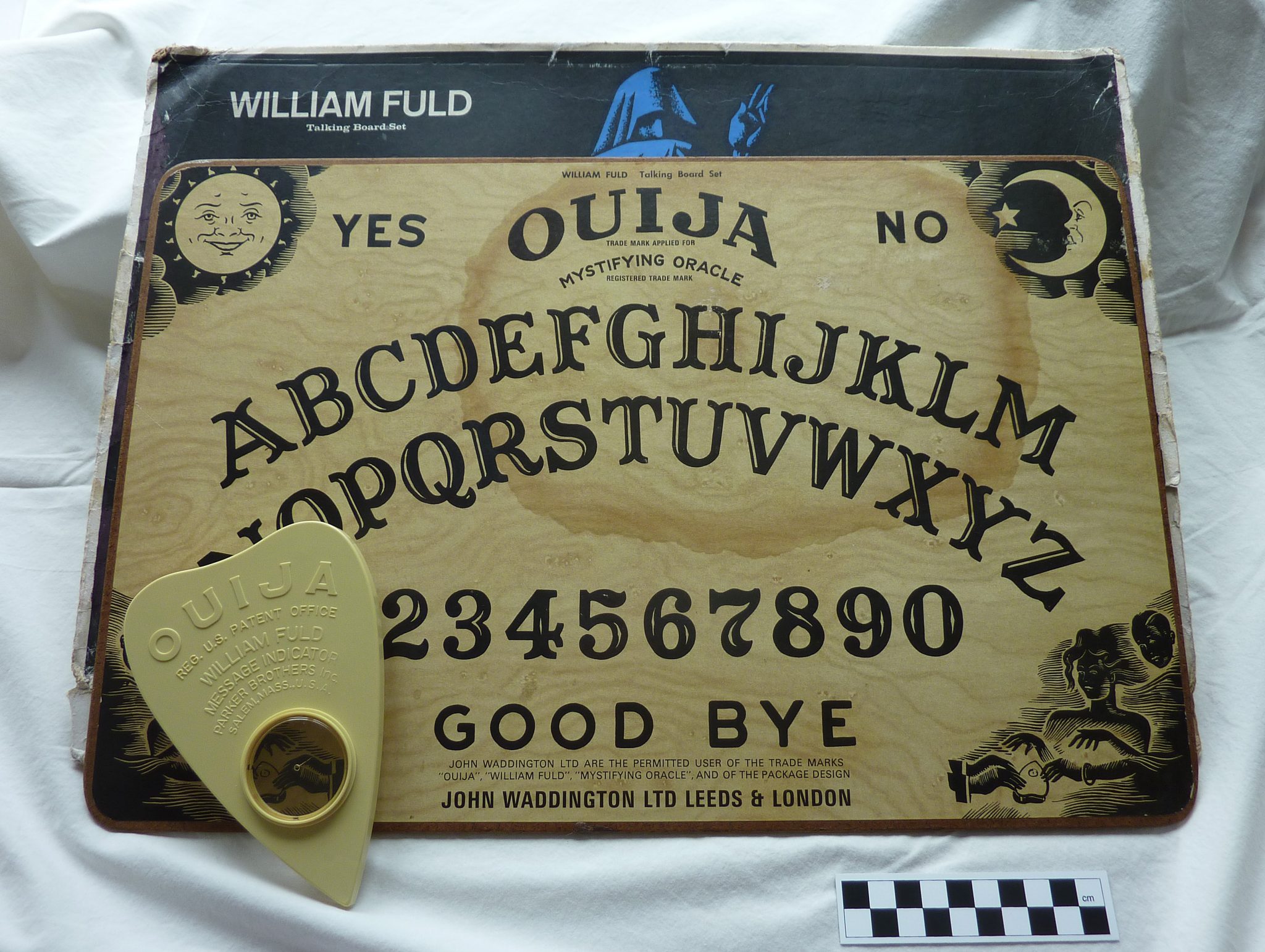
1146 – Ouija Board, with planchette and box
- Physical description:
- Waddington copy of the William Fuld Ouija Board (see MoW no. 1145), but slightly smaller. White plastic planchette. Box with spooky shrouded figure, and the words, 'Never-failing amusement and recreation for the entire family.'
- Museum classification:
- Divination
- Size:
- 310 x 450 x 30 mm (in box); planchette 160 x 100
- Information:
Donated in 2002 by Gerard Hutton.
American Spiritualist groups began using boards to assist them with contacting the Spirit World in the 1880s. In 1890 the Kennard Novelty Company was founded with the intention of making boards available to the general public. Although the name Kennard Novelty Company suggests that the boards were intended as games, one of the people involved in forming the company, Elijah Bond, was the brother-in-law of a respected Spiritualist medium, Helen Peters. So it seems that the concepts of Ouija Boards as a serious aid to Spiritualist practice and as a form of entertainment were already blurred at this point, perhaps making controversy around their use inevitable.
William Fuld took over the Kennard Novelty Company in 1892, and it became the William Fuld Manufacturing Company in 1901. After his death in 1927 his children ran the company until it was taken over by Parker Brothers in 1966. The British company Waddington had an agreement with Parker Brothers to manufacture some of their products in Britain, and produced their first Ouija Board, which was almost identical to the 1960s Fuld boards, in 1968.
- Resource:
- Object
- Materials:
- Wood, paper, card, plastic
Donated in 2002 by Gerard Hutton.
American Spiritualist groups began using boards to assist them with contacting the Spirit World in the 1880s. In 1890 the Kennard Novelty Company was founded with the intention of making boards available to the general public. Although the name Kennard Novelty Company suggests that the boards were intended as games, one of the people involved in forming the company, Elijah Bond, was the brother-in-law of a respected Spiritualist medium, Helen Peters. So it seems that the concepts of Ouija Boards as a serious aid to Spiritualist practice and as a form of entertainment were already blurred at this point, perhaps making controversy around their use inevitable.
William Fuld took over the Kennard Novelty Company in 1892, and it became the William Fuld Manufacturing Company in 1901. After his death in 1927 his children ran the company until it was taken over by Parker Brothers in 1966. The British company Waddington had an agreement with Parker Brothers to manufacture some of their products in Britain, and produced their first Ouija Board, which was almost identical to the 1960s Fuld boards, in 1968.