1144 – Sculpture – Hare Woman
- Physical description:
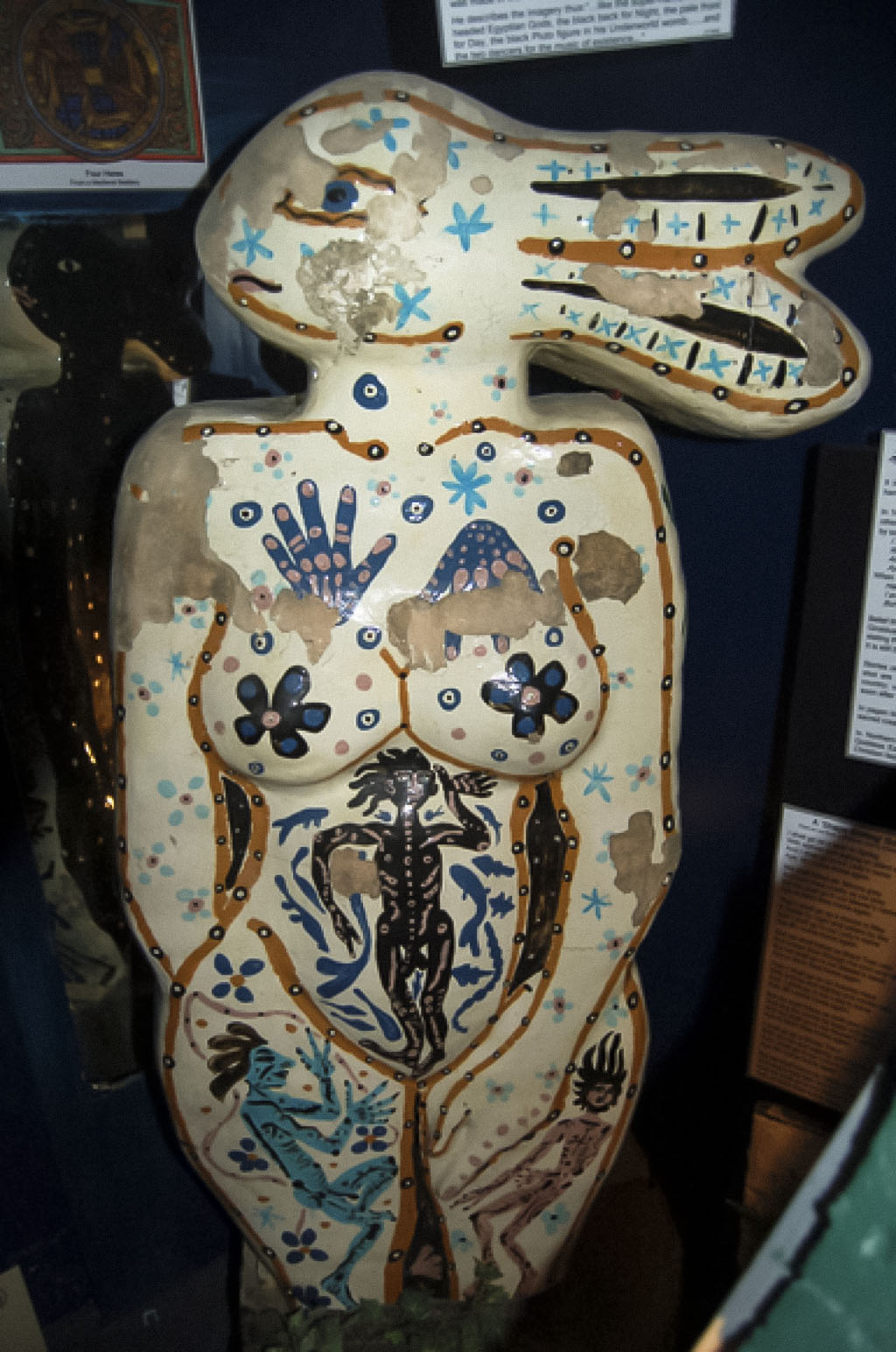
- Large, colourful ceramic sculpture of Hare Woman - woman with hare's head. Front painted with figures, flowers, fish etc., back painted black with a pattern of white, blue and pink circles. Made by Lionel Miskin.
- Museum classification:
- Hare
- Size:
- 1000 x 400 x 200 mm (approx.)
- Information:
The Hare-Woman.
One day during the summer of 1997 a charming couple got into conversation at the desk. After chatting for a while they mentioned that they had made an odd discovery of a large ceramic 'hare woman' beneath a caravan on their land. They told us 'We have no use for her, but we think she belongs here'. We agreed, and gratefully accepted their kind offer.
So the Hare-Woman came to the Museum, and until June 1999 the mystery surrounding her origin and inspiration remained. That she was made by someone with knowledge and interest in the world of magical symbolism was obvious, but who? Then, after a newspaper feature on the Museum which was illustrated by a large photograph of the Hare-Woman, we were contacted by the artist, Lionel Miskin, who made her during the 1960's.
He calls her his 'big Bunny Girl', and describes how he came to make the piece;
'...my work associated the actual Playboy Bunny Girls with ancient tribal identifications with certain animals, dropping the specifically human aspects of consciousness in exchange for animal instincts. These instincts were held in the deepest respect by many cultures, as containing the deep knowledge and wisdom of nature.'
Talking about the imagery used in the piece he says;
'...like the super-human animal headed Egyptian Gods, the black back for Night, the pale front for Day, the black Pluto figure in his Underworld womb......and the two dancers for the Music of existence...'
From the Bunny Girl to shape-shifting witches, animal totems and underworld 'spirit guides', Lionel Miskin's Hare-Woman contains numerous references to the enduring power and symbolism of the hare or rabbit.
We are delighted to exhibit this remarkable and powerful piece in the Museum of Witchcraft.
(Lionel Miskin died in February 2006, aged 81. He studied at St Martin's School of Art in London, before moving to Mevagissey in 1949. He ran a pottery there for several years, and also, in 1958, illustrated Charles Causley's book 'The Balled of Charlotte Dymond'. In the 1960s he taught at Falmouth School of Art. He then went to live in Cyprus, before returning to the south-west and settling in Bovey Tracey in 1993. Throughout his career he had a reputation as a humorist and rebel.)- Resource:
- Object
- Materials:
- Ceramic
The Hare-Woman.
One day during the summer of 1997 a charming couple got into conversation at the desk. After chatting for a while they mentioned that they had made an odd discovery of a large ceramic 'hare woman' beneath a caravan on their land. They told us 'We have no use for her, but we think she belongs here'. We agreed, and gratefully accepted their kind offer.
So the Hare-Woman came to the Museum, and until June 1999 the mystery surrounding her origin and inspiration remained. That she was made by someone with knowledge and interest in the world of magical symbolism was obvious, but who? Then, after a newspaper feature on the Museum which was illustrated by a large photograph of the Hare-Woman, we were contacted by the artist, Lionel Miskin, who made her during the 1960's.
He calls her his 'big Bunny Girl', and describes how he came to make the piece;
'...my work associated the actual Playboy Bunny Girls with ancient tribal identifications with certain animals, dropping the specifically human aspects of consciousness in exchange for animal instincts. These instincts were held in the deepest respect by many cultures, as containing the deep knowledge and wisdom of nature.'
Talking about the imagery used in the piece he says;
'...like the super-human animal headed Egyptian Gods, the black back for Night, the pale front for Day, the black Pluto figure in his Underworld womb......and the two dancers for the Music of existence...'
From the Bunny Girl to shape-shifting witches, animal totems and underworld 'spirit guides', Lionel Miskin's Hare-Woman contains numerous references to the enduring power and symbolism of the hare or rabbit.
We are delighted to exhibit this remarkable and powerful piece in the Museum of Witchcraft.
(Lionel Miskin died in February 2006, aged 81. He studied at St Martin's School of Art in London, before moving to Mevagissey in 1949. He ran a pottery there for several years, and also, in 1958, illustrated Charles Causley's book 'The Balled of Charlotte Dymond'. In the 1960s he taught at Falmouth School of Art. He then went to live in Cyprus, before returning to the south-west and settling in Bovey Tracey in 1993. Throughout his career he had a reputation as a humorist and rebel.)