1800 – Sea bean: Amulet
- Physical description:
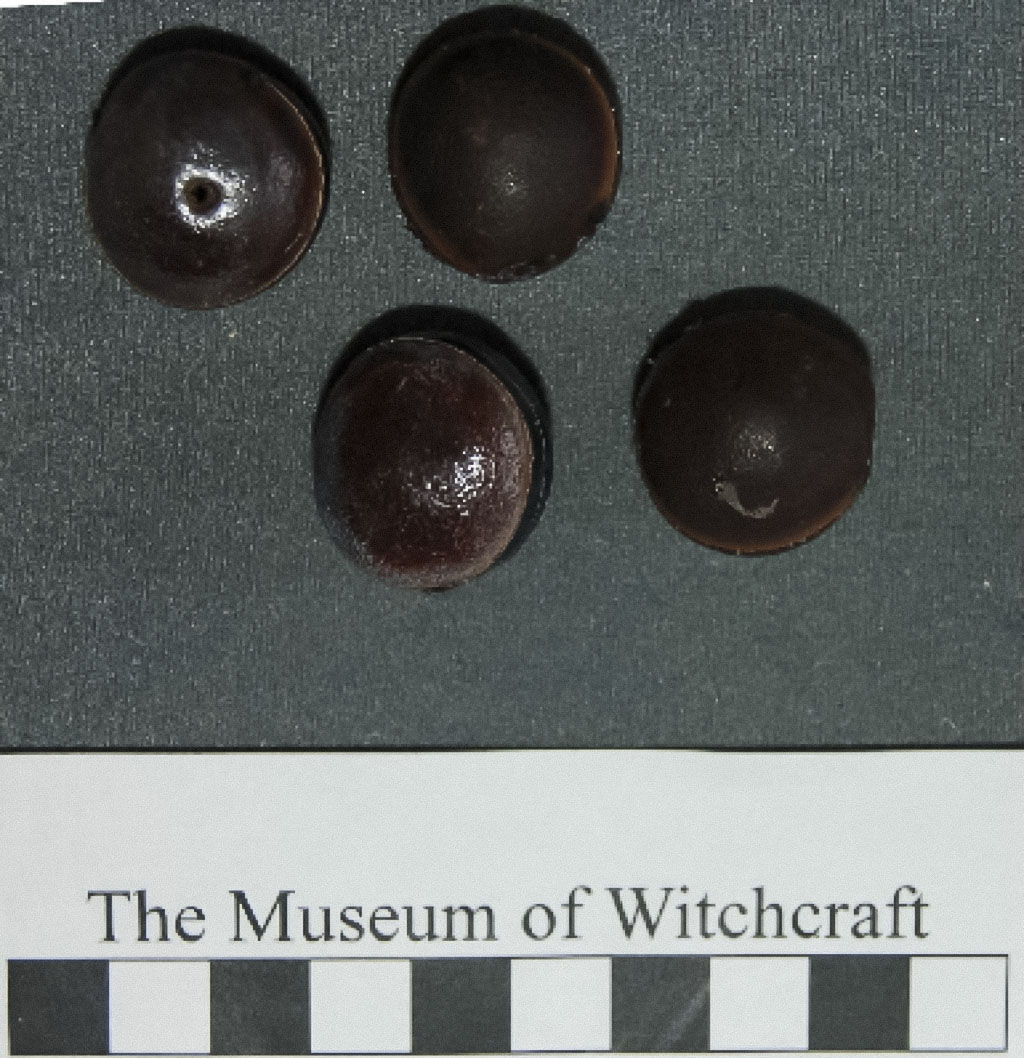
- 4 sea beans, round and dark brown with a black band. Possibly used as amulets.
- Museum classification:
- Sea Witchcraft
- Size:
- Approx 25 diam x 20
- Information:
See also 1945 and 1946.
These are seeds from tropical vines of the Mucuna species, which grow in the cloud forests and rain forests of Central and South America. They are carried to the shores of northern European countries - particularly Cornwall, Scotland, Iceland, the Faeroes and Norway - on the Gulf Stream, and can occasionally be found on the strandline of beaches. These four have holes drilled through them so they can be strung on thread.
Sea beans have been prized for their magical power for centuries. An Icelandic poem describes the Br'singamen, the priceless treasure of the Goddess Freyja, as a 'sea kidney' - a kidney-shaped sea bean.
In Scotland these brown beans with a dark ring were worn to bring prosperity (John Morisone, late 17th century).
See 'Drift Seeds and the Brisingamen' by Audrey Meaney, 'Folklore' vol. 94:i 1983.- Resource:
- Object
- Materials:
- Plant
- Copyright ownership:
- Treetrunk Ltd
See also 1945 and 1946.
These are seeds from tropical vines of the Mucuna species, which grow in the cloud forests and rain forests of Central and South America. They are carried to the shores of northern European countries - particularly Cornwall, Scotland, Iceland, the Faeroes and Norway - on the Gulf Stream, and can occasionally be found on the strandline of beaches. These four have holes drilled through them so they can be strung on thread.
Sea beans have been prized for their magical power for centuries. An Icelandic poem describes the Br'singamen, the priceless treasure of the Goddess Freyja, as a 'sea kidney' - a kidney-shaped sea bean.
In Scotland these brown beans with a dark ring were worn to bring prosperity (John Morisone, late 17th century).
See 'Drift Seeds and the Brisingamen' by Audrey Meaney, 'Folklore' vol. 94:i 1983.