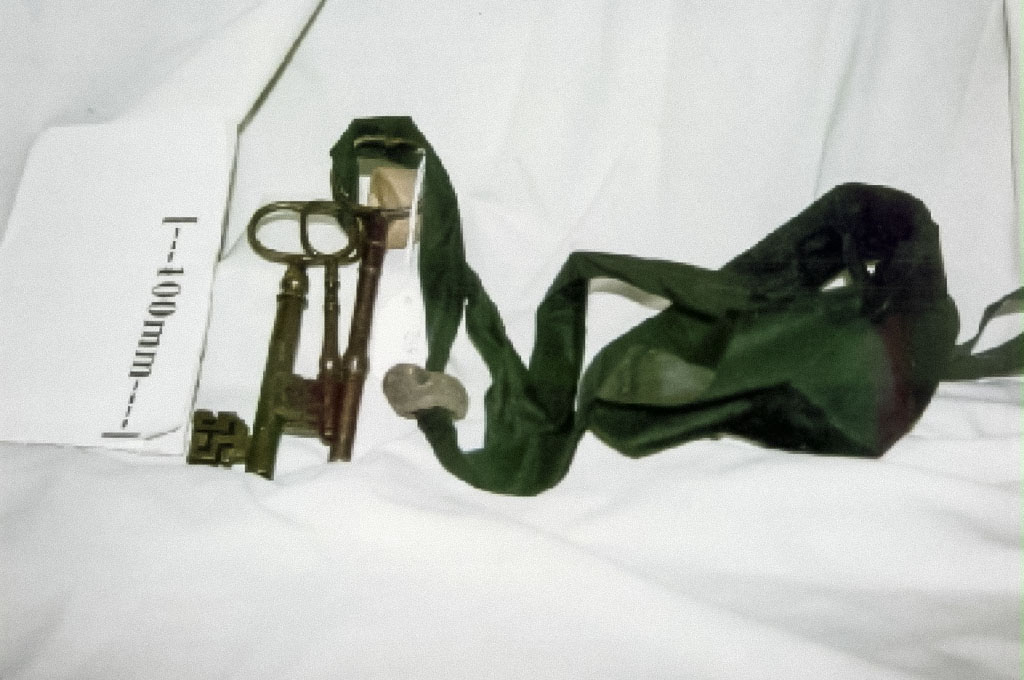
487 – KEYS AND HAGSTONES WITH BLACK RIBBON
- Physical description:
- 3 large keys on a black ribbon with 2 hagstones (holed stones).
- Museum classification:
- Working Tools
- Size:
- 420x65x35
- Information:
Original text by Cecil Williamson: 'Broad black ribbon, two holed stones and two church door keys. No, the church keys were not stolen. They are duplicates made secretly. The reason is simple. When Christianity supplanted the native religion of the English tribes, and following St. Augustine's command they tore down the temples of the heathens and established the church of Christ upon these sacred and sensitive sites. So the present day witch not to be deprived of the use of these sacred pulse spots of nature, enters the church at night when all good Christians are asleep, and quietly and with decorum makes her meditations. Making sure to lock up when she departs with the dawn.'
A visitor to the museum has provided us with some more information about the use of keys as protection charms. The number of keys used may depend on the type of home to be protected. A set of three iron keys and a hagstone have been passed down through her family for generations as a protection charm for a farm. Another family member, who lives in a town, has seven keys and a hagstone; while a third family member has nine keys and a hagstone. For protection, the keys have to be old iron ones. Modern keys, however, can be used as good luck charms. It is also often the custom in her family to give a small gold key charm as a gift to a baby - to unlock good luck for the future.
The Lovett Collection in the Cuming Museum includes a charm consisting of an iron key tied with string to a ram's horn. According to Edward Lovett it was a charm against witches.
Scarborough Museum has two charms consisting of hagstones and keys. One is a "holey stone" and an old key that was hung in a cottage as a charm against witchcraft, and was collected in Devon in 1913; the other is a hagstone with two old keys that was hung on a stable door to keep witches away and was collected in Suffolk in 1913. Scarborough Museum also has an interesting charm consisting of three hagstones and part of the pelvic bone of a sheep with a natural hole, all threaded together with string and sold by a wise woman as a charm to keep away witches, and from Exmouth, c.1910. (See Tabitha Cadbury's report 'The Clarke Collection of Charms and Amulets' in the museum library.)
There is also a hagstone and iron key amulet in the Pitt Rivers Museum.
A visitor to the museum from Germany has told us that her parents, who used to live in an old farmhouse in Bavaria, had a hagstone ring hanging up in the house and also a hagstone attached to their house keys.
In northern counties these stones are known as dobbie stones, and often hung in animal sheds on farms (or attached to the keyring for the animal sheds) to protect livestock (information from visitors to the museum, and from an article by John Billingsley on the Northern Earth website, www.northernearth.co.uk).
In Switzerland, hagstones are traditionally tied with red thread, and for keys to have magical protecting power they must be church keys, and the end should be in the shape of a cross. It was also believed that if a vicar looked through the hole in the centre of the cross-shape during the Sunday Service, he would be able to see which members of the congregation were witches. (Information supplied by Wicca Meier-Spring of Hexenmuseum Schweiz.)- Materials:
- metal, stone, ribbon
- Copyright ownership:
- Copyright to The Museum of Witchcraft Ltd.
Original text by Cecil Williamson: 'Broad black ribbon, two holed stones and two church door keys. No, the church keys were not stolen. They are duplicates made secretly. The reason is simple. When Christianity supplanted the native religion of the English tribes, and following St. Augustine's command they tore down the temples of the heathens and established the church of Christ upon these sacred and sensitive sites. So the present day witch not to be deprived of the use of these sacred pulse spots of nature, enters the church at night when all good Christians are asleep, and quietly and with decorum makes her meditations. Making sure to lock up when she departs with the dawn.'
A visitor to the museum has provided us with some more information about the use of keys as protection charms. The number of keys used may depend on the type of home to be protected. A set of three iron keys and a hagstone have been passed down through her family for generations as a protection charm for a farm. Another family member, who lives in a town, has seven keys and a hagstone; while a third family member has nine keys and a hagstone. For protection, the keys have to be old iron ones. Modern keys, however, can be used as good luck charms. It is also often the custom in her family to give a small gold key charm as a gift to a baby - to unlock good luck for the future.
The Lovett Collection in the Cuming Museum includes a charm consisting of an iron key tied with string to a ram's horn. According to Edward Lovett it was a charm against witches.
Scarborough Museum has two charms consisting of hagstones and keys. One is a "holey stone" and an old key that was hung in a cottage as a charm against witchcraft, and was collected in Devon in 1913; the other is a hagstone with two old keys that was hung on a stable door to keep witches away and was collected in Suffolk in 1913. Scarborough Museum also has an interesting charm consisting of three hagstones and part of the pelvic bone of a sheep with a natural hole, all threaded together with string and sold by a wise woman as a charm to keep away witches, and from Exmouth, c.1910. (See Tabitha Cadbury's report 'The Clarke Collection of Charms and Amulets' in the museum library.)
There is also a hagstone and iron key amulet in the Pitt Rivers Museum.
A visitor to the museum from Germany has told us that her parents, who used to live in an old farmhouse in Bavaria, had a hagstone ring hanging up in the house and also a hagstone attached to their house keys.
In northern counties these stones are known as dobbie stones, and often hung in animal sheds on farms (or attached to the keyring for the animal sheds) to protect livestock (information from visitors to the museum, and from an article by John Billingsley on the Northern Earth website, www.northernearth.co.uk).
In Switzerland, hagstones are traditionally tied with red thread, and for keys to have magical protecting power they must be church keys, and the end should be in the shape of a cross. It was also believed that if a vicar looked through the hole in the centre of the cross-shape during the Sunday Service, he would be able to see which members of the congregation were witches. (Information supplied by Wicca Meier-Spring of Hexenmuseum Schweiz.)