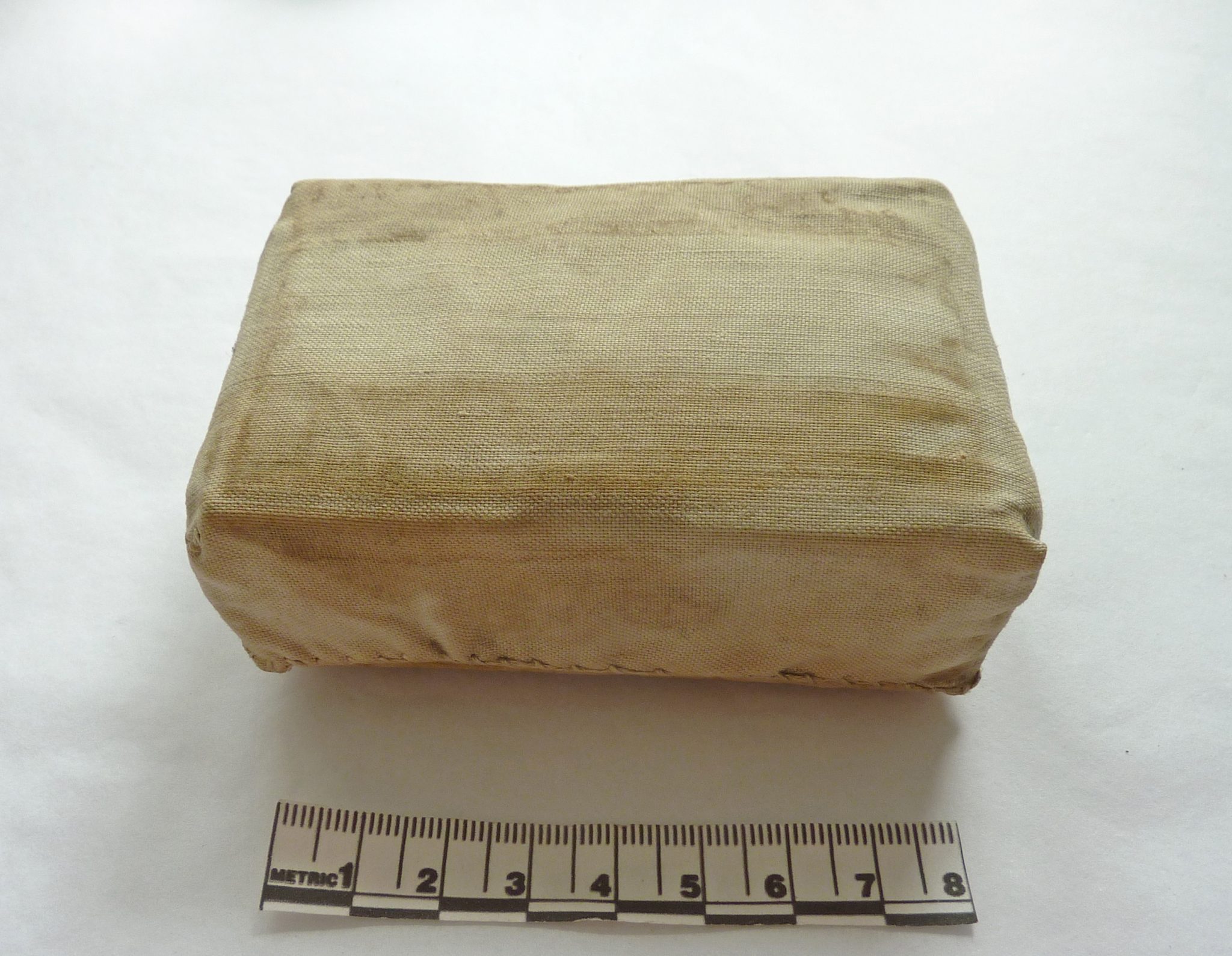
68 – Get lost Box
- Physical description:
- A get-lost box covered in white cloth.
- Museum classification:
- Spells & Charms
- Size:
- 95 x 60 mm
- Information:
Original text by Cecil Williamson: 'The old fashioned method favoured by Cornish sea witches was to stitch a cloth covering around their get-lost boxes, this one was prepared for me by a Falmouth based sea witch.'
Some Swiss visitors told us that a method of curing illness still used in Switzerland consists of the sick person putting a piece of rice paper in their mouth, visualising the illness passing from them into the paper, then putting the paper into a wooden box and putting the box on the fire.
The Lovett Collection in the Cuming Museum has three pieces of bread that record a method used in early 20th century London to transfer whooping cough to a dog - hair from the sick person was put between pieces of bread and fed to the dog.
The Cornish researcher William Henry Paynter recorded the custom of rubbing warts with a cinder and putting the cinder in a box, which was then left in the road to transfer the wart to whoever picked the box up (see 'The Cornish Witch-finder', edited by Jason Semmens). A visitor to the museum, related to Paynter (who was his grandfather's sister's husband) told us that Paynter cured some warts he had using two methods - one was to rub the warts with a piece of meat and then bury it; in the other, Paynter used an old penny that he had about him, the warts had to be rubbed with the penny and then the penny passed on to someone else, passing the warts on with it.
A visitor to the museum who lives in Reunion Island told us that there was a tradition there of using magic to transfer illness or misfortune from a human to a duck or chicken. The bird was then killed and the body left at a crossroads. If anyone was foolish enough to touch it the illness or misfortune would be transferred to them. Even today, traffic chaos can result if people see a dead chicken or duck at a crossroads, as they will go to great lengths to avoid driving over it.
- Resource:
- Object
- Materials:
- Wood, cloth
- Copyright ownership:
- Copyright to The Museum of Witchcraft Ltd.
Original text by Cecil Williamson: 'The old fashioned method favoured by Cornish sea witches was to stitch a cloth covering around their get-lost boxes, this one was prepared for me by a Falmouth based sea witch.'
Some Swiss visitors told us that a method of curing illness still used in Switzerland consists of the sick person putting a piece of rice paper in their mouth, visualising the illness passing from them into the paper, then putting the paper into a wooden box and putting the box on the fire.
The Lovett Collection in the Cuming Museum has three pieces of bread that record a method used in early 20th century London to transfer whooping cough to a dog - hair from the sick person was put between pieces of bread and fed to the dog.
The Cornish researcher William Henry Paynter recorded the custom of rubbing warts with a cinder and putting the cinder in a box, which was then left in the road to transfer the wart to whoever picked the box up (see 'The Cornish Witch-finder', edited by Jason Semmens). A visitor to the museum, related to Paynter (who was his grandfather's sister's husband) told us that Paynter cured some warts he had using two methods - one was to rub the warts with a piece of meat and then bury it; in the other, Paynter used an old penny that he had about him, the warts had to be rubbed with the penny and then the penny passed on to someone else, passing the warts on with it.
A visitor to the museum who lives in Reunion Island told us that there was a tradition there of using magic to transfer illness or misfortune from a human to a duck or chicken. The bird was then killed and the body left at a crossroads. If anyone was foolish enough to touch it the illness or misfortune would be transferred to them. Even today, traffic chaos can result if people see a dead chicken or duck at a crossroads, as they will go to great lengths to avoid driving over it.