
723 – Bezoar Stone
- Physical description:
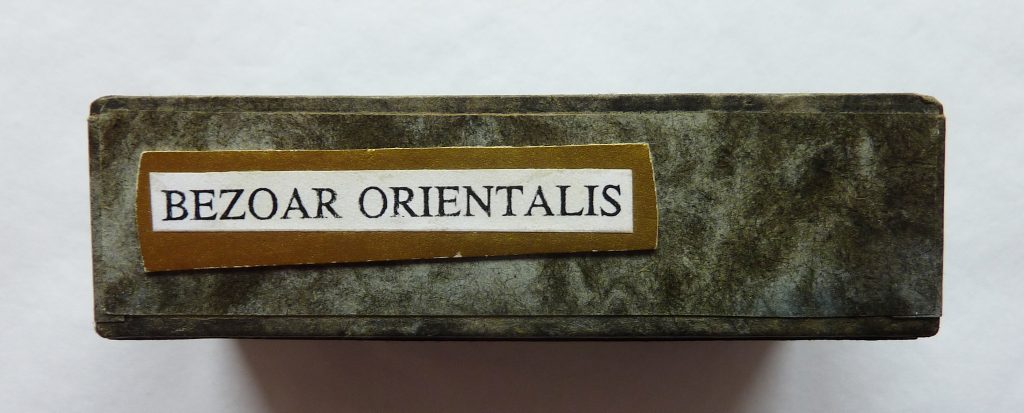
- Very shiny reddish brown stone (in fact a concretion from the digestive system of animals); resembles a large bean. In a box labelled "bezoar orientalis".
- Museum classification:
- Richel Collection
- Size:
- 50 x 24 x 24mm
- Information:
A famous magical antidote to poison, mentioned in J.K. Rowling's 'Harry Potter' books.
The word 'bezoar' comes from the Persian 'pad-zahr', meaning 'protection from poison'.
The stones form in the intestines of animals who chew the cud, particularly goats. The wild goats who live in Turkey, Iran and Pakistan are called bezoar goats.From the Richel Collection.
This particular example is probably a goat bezoar from India. See:
https://cmjournal.biomedcentral.com/articles/10.1186/s13020-018-0182-0
Clarifying the origin of Houzao
Zhongzhen Zhao, Eric Brand, Hiu Yee Kwan, Quanbin Han & Mengjia Zhou
Published: 03 May 2018
The bezoar stones investigated in this article were found in the digestive tract of goats in India. They were shiny and dark brown or dark green, and oval in shape.
They were formed around an irritant such as an acacia seed, and composed of a phosphate-carbonate concretion.
They are used in Chinese medicine.
In the United States bezoar stones (usually from the stomachs of deer) were known as "mad stones" because they were used as a treatment for the bite of a mad dog. The stone was placed on the bite to draw out the poison. (Thanks to Dr Georgia Rhoades for this information.)
The Lenkiewicz Manuscript (a late 16th or early 17th century cunning person's notebook) in the Museum library (133.4 UNK 5148) mentions magical stones found in the stomach of a swallow: "Ffirst goe to the place, wher the swallow hath her neste with 4 younge ones & binde one of them uppon the neste by the space of iiii dayes & the 4 daye take him oute of the neste & cutt him in the middle, & you shall finde within the belly of yt iii stones of divers collours, the one browne of collour, the second is redd, the third is white. The vertue of the firste is, if thou wilt give it to any woman that travaileth with child she shal be spedely dd [delivered ?] /2/ the vertue of the redd stone is if thou wilte put it in thy mouth, thou shalt obtaine any thinge thou wilte demande /3/ The vertue of the white stone is if any man beare it with him, he shall not be a thriste [thirsty], as longe as he hath the said stone with him." The Bedouin of the Sinai Desert carry carefully selected pebbles which they put under their tongues to relieve thirst, particularly during Ramadan, when they observe a strict fast, eating and drinking nothing between sunrise and sunset. (Source: 'Al Jazeera World: Son of the Desert', broadcast on Al Jazeera in July 2014.)Thiis was one of the objects on loan to York Archaeological Trust for exhibition at the Merchant Adventurers' Hall from July 18th 2018 - February 19th 2019.
Also on loan to the 'Wicked Spirits?' exhibition at Colchester Castle Museum in 2022.
- Resource:
- Object
- Materials:
- animal part
- Copyright ownership:
- Copyright to The Museum of Witchcraft Ltd.
A famous magical antidote to poison, mentioned in J.K. Rowling's 'Harry Potter' books.
The word 'bezoar' comes from the Persian 'pad-zahr', meaning 'protection from poison'.
The stones form in the intestines of animals who chew the cud, particularly goats. The wild goats who live in Turkey, Iran and Pakistan are called bezoar goats.
From the Richel Collection.
This particular example is probably a goat bezoar from India. See:
https://cmjournal.biomedcentral.com/articles/10.1186/s13020-018-0182-0
Clarifying the origin of Houzao
Zhongzhen Zhao, Eric Brand, Hiu Yee Kwan, Quanbin Han & Mengjia Zhou
Published: 03 May 2018
The bezoar stones investigated in this article were found in the digestive tract of goats in India. They were shiny and dark brown or dark green, and oval in shape.
They were formed around an irritant such as an acacia seed, and composed of a phosphate-carbonate concretion.
They are used in Chinese medicine.
In the United States bezoar stones (usually from the stomachs of deer) were known as "mad stones" because they were used as a treatment for the bite of a mad dog. The stone was placed on the bite to draw out the poison. (Thanks to Dr Georgia Rhoades for this information.)
The Lenkiewicz Manuscript (a late 16th or early 17th century cunning person's notebook) in the Museum library (133.4 UNK 5148) mentions magical stones found in the stomach of a swallow: "Ffirst goe to the place, wher the swallow hath her neste with 4 younge ones & binde one of them uppon the neste by the space of iiii dayes & the 4 daye take him oute of the neste & cutt him in the middle, & you shall finde within the belly of yt iii stones of divers collours, the one browne of collour, the second is redd, the third is white. The vertue of the firste is, if thou wilt give it to any woman that travaileth with child she shal be spedely dd [delivered ?] /2/ the vertue of the redd stone is if thou wilte put it in thy mouth, thou shalt obtaine any thinge thou wilte demande /3/ The vertue of the white stone is if any man beare it with him, he shall not be a thriste [thirsty], as longe as he hath the said stone with him." The Bedouin of the Sinai Desert carry carefully selected pebbles which they put under their tongues to relieve thirst, particularly during Ramadan, when they observe a strict fast, eating and drinking nothing between sunrise and sunset. (Source: 'Al Jazeera World: Son of the Desert', broadcast on Al Jazeera in July 2014.)
Thiis was one of the objects on loan to York Archaeological Trust for exhibition at the Merchant Adventurers' Hall from July 18th 2018 - February 19th 2019.
Also on loan to the 'Wicked Spirits?' exhibition at Colchester Castle Museum in 2022.